
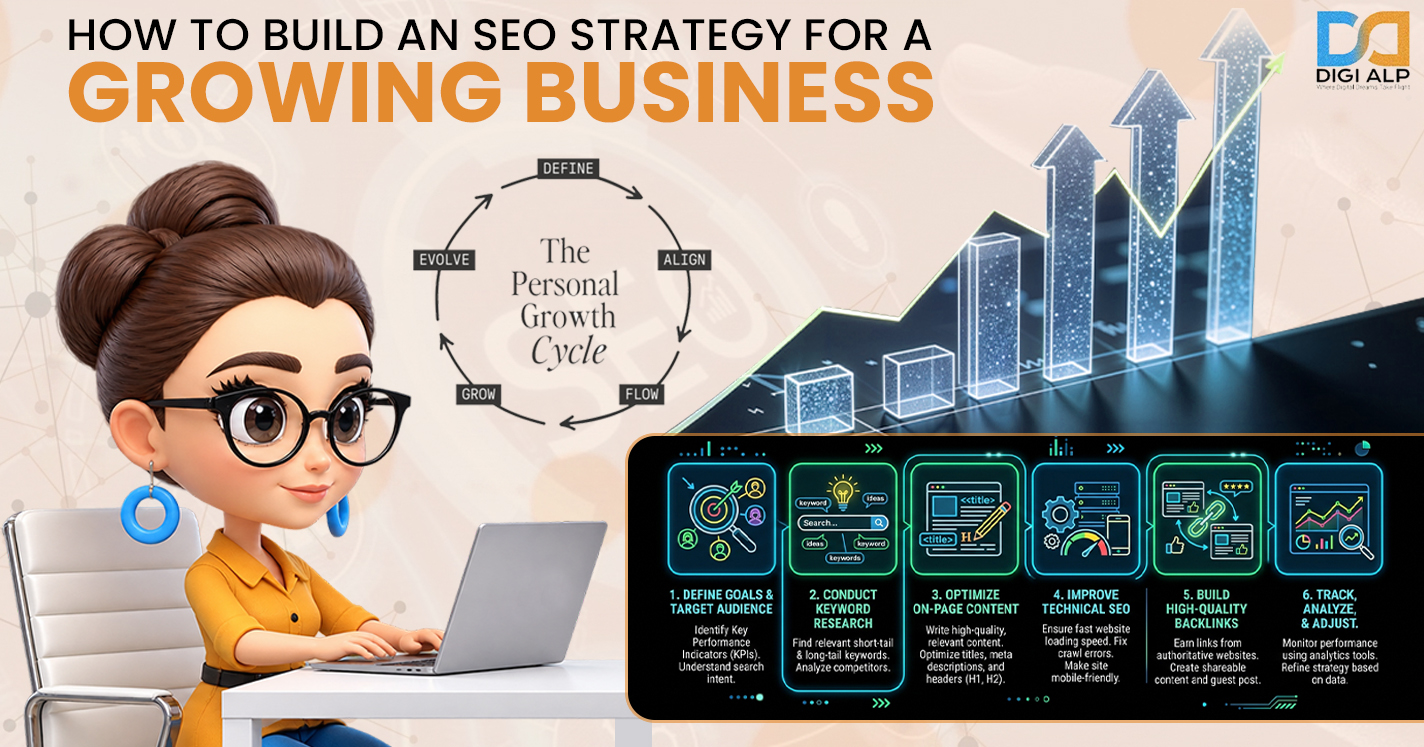
Growing a business online is not just about getting more website visitors. You need to attract the right people, appear for searches that matter to your business, build trust, and turn organic traffic into leads or customers.That is where a well-planned SEO strategy for growing business becomes important.
For a small company or startup, SEO can be especially valuable because it helps build a long-term source of organic visibility. Instead of depending entirely on paid advertising or social media, your website can attract people who are actively searching for your products, services, solutions, or expertise.However, SEO is not simply adding keywords to pages and publishing blogs.
A strong SEO strategy for small business combines keyword research, search intent, technical SEO, content, internal linking, authority building, local SEO, conversion optimization, and continuous measurement.This guide explains how to create an SEO strategy that can grow with your business.
What Is an SEO Strategy for a Growing Business?
An SEO strategy is a structured plan for improving a website’s visibility in search engines and attracting relevant organic traffic.
For a growing business, an effective SEO strategy can include:
- Keyword research
- Search intent analysis
- Competitor research
- Technical SEO
- On-page optimization
- Content creation
- Internal linking
- Link building
- Local SEO
- Conversion rate optimization
- Performance tracking
The objective is not to rank for every possible keyword.Instead, you want your website to appear for searches made by people who are likely to become customers.That means your business SEO strategy should connect SEO activities to actual business goals.
Why SEO Matters for Growing Businesses
Small and growing businesses often compete against larger companies with bigger marketing budgets.SEO gives smaller companies an opportunity to build visibility by targeting relevant topics and search queries instead of competing for every broad keyword.
For example, a new software company may struggle to compete immediately for a broad term such as “software development.”
A more focused strategy could target searches related to:
- Software development for startups
- Custom software development services
- AI software development
- Ecommerce development
- Healthcare software development
These more specific searches can help a business reach audiences with clearer needs.
DigiAlp’s current digital marketing approach combines SEO, content, paid media, social media, analytics, and conversion-focused marketing rather than treating each channel as an isolated activity.This is an important concept for growing businesses: SEO should support your overall marketing strategy.
Step 1: Define Your Business and SEO Goals
Before researching keywords, define what you want SEO to accomplish.Your objectives could include:
- Generate more leads
- Increase online sales
- Increase organic traffic
- Build brand awareness
- Reach new locations
- Generate qualified inquiries
- Increase product visibility
- Build authority in your industry
- Reduce dependence on paid traffic
Your goals should be specific enough to measure.For example:
Weak goal:
“Get more Google traffic.”
Better goal:
“Increase qualified organic traffic to our service pages and generate more monthly leads from search.”
This difference helps you choose the right keywords, content, and metrics.A growing company should always ask:
How will SEO contribute to business growth?
Step 2: Understand Your Target Audience
A successful small business SEO strategy starts with understanding your customers.Before choosing keywords, identify:
- Who your ideal customers are
- What problems they have
- What products or services they need
- What questions they ask
- What objections they have
- What locations they search from
- What alternatives they consider
- What makes them choose one company over another
Think about what your customers search before they are ready to buy.For example, someone looking for SEO services might search:
Informational:
“What is SEO?”
Then:
Problem-focused:
“Why is my website not ranking?”
Then:
Commercial:
“SEO services for small business”
Finally:
Transactional:
“SEO agency for small business”
A strong SEO strategy can create content for each stage.
Step 3: Perform Keyword Research
Keyword research helps you discover what your potential customers search for.But search volume should not be your only consideration.
Evaluate keywords based on:
- Relevance
- Search intent
- Search volume
- Competition
- Business value
- Conversion potential
- Geographic relevance
For example, a keyword with 10,000 monthly searches may sound attractive, but if the searchers are not potential customers, it may provide little business value.A keyword with 500 searches could be more valuable if those searches come from people actively looking for your service.For startups, this is particularly important.
An SEO strategy for startups should usually prioritize relevant, specific, and achievable search opportunities before trying to compete for extremely broad terms.
Step 4: Group Keywords by Search Intent
Once you have a keyword list, organize it according to search intent.
Informational intent
The user wants information.
Examples:
- How does SEO work?
- What is technical SEO?
- How to improve Google rankings
Commercial investigation
The user is evaluating solutions.
Examples:
- Best SEO services for startups
- SEO agency vs freelancer
- Local SEO services comparison
Transactional intent
The user is ready to take action.
Examples:
- SEO services for small businesses
- Hire SEO agency
- Small business SEO company
Navigational intent
The user is looking for a specific website or brand.
This classification helps you decide which keywords belong on service pages and which belong in blog content.
Step 5: Build Topic Clusters
One of the biggest mistakes businesses make is creating separate pages for every keyword variation.Instead, build topic clusters.
For example, if your primary topic is SEO for small businesses, supporting topics could include:
- Local SEO for small businesses
- Technical SEO for small businesses
- Keyword research for small businesses
- Content marketing for small businesses
- Link building for small businesses
- SEO reporting
- Small business SEO mistakes
- SEO vs paid advertising
A main guide can link to supporting articles, while supporting articles link back to the main guide and relevant service pages.This creates a logical website structure.
Step 6: Optimize Your Important Website Pages
Before publishing dozens of blog posts, make sure your most important pages are optimized.
These may include:
- Homepage
- Service pages
- Product pages
- Category pages
- Industry pages
- Location pages
- About page
- Contact page
Each page should target a clear topic and search intent.
Pay attention to:
Title tags
Create unique, descriptive titles that communicate the page’s subject.
H1 heading
Clearly explain what the page is about.
H2 and H3 headings
Organize the content around useful subtopics.
Page copy
Explain your service or product in a way that addresses customer needs.
Internal links
Connect related pages and guide users toward useful information.
Images
Use descriptive filenames and relevant alt text.
Calls to action
Give visitors a clear next step.
For a growing company, optimizing commercial pages is particularly important because blog traffic has limited value if visitors cannot easily discover your services.
Step 7: Create a Content Strategy
Content should support your SEO goals rather than simply increase the number of pages on your website.A strong content strategy can include several types of articles.
Educational Content
These articles answer questions.
Examples:
- What Is SEO?
- How Does Local SEO Work?
- What Is Technical SEO?
Problem-Solving Content
These address customer challenges.
Examples:
- Why Is My Website Not Ranking?
- How to Improve Organic Traffic
- Common SEO Problems Small Businesses Face
Comparison Content
These help customers evaluate options.
Examples:
- SEO vs Google Ads
- SEO Agency vs Freelancer
- Local SEO vs National SEO
Commercial Content
These target users closer to conversion.
Examples:
- SEO Services for Small Businesses
- SEO Services for Startups
- Local SEO Services
This approach helps your website attract visitors at different stages of the buying journey.
DigiAlp’s website positions content marketing as part of its broader digital marketing offering, alongside SEO, paid media, social media, and analytics.
Step 8: Use Internal Linking to Strengthen Your SEO
Internal linking is one of the easiest SEO improvements businesses can implement.When you publish a new article, look for opportunities to link it to relevant:
- Service pages
- Related blog posts
- Industry pages
- Case studies
- Contact pages
For example, when discussing how SEO fits into a broader growth strategy, you can link naturally to DigiAlp’s Digital Marketing Services, which combines SEO, content, paid media, social media, and analytics.
When discussing conversion optimization, you can link to DigiAlp’s CRO guide as a supporting resource.Internal linking should always be useful to the reader.Do not add links simply to increase the number of links on a page.
A good internal link answers the question:
“What useful page would the reader want to visit next?”
Step 9: Improve Technical SEO
A great content strategy cannot perform effectively if your website has serious technical problems.
Your technical SEO checklist should include:
- Mobile responsiveness
- Page speed
- Core Web Vitals
- HTTPS
- XML sitemap
- Robots.txt
- Crawlability
- Indexability
- Canonical URLs
- Broken links
- Redirects
- Duplicate content
- Structured data
- Clean URL structure
Technical SEO becomes increasingly important as a website grows.A small website with 20 pages is relatively easy to manage.A growing website with hundreds of pages needs a clear architecture and consistent technical standards.
Your website should make it easy for both users and search engines to understand:
What is this page?
How does it relate to other pages?
Where should the visitor go next?
Step 10: Build Topical Authority
Modern SEO should not focus only on individual keywords.Your website should demonstrate depth around the subjects that matter to your business.Suppose you provide digital marketing services.
Instead of publishing random articles about unrelated marketing topics, build content around areas such as:
- SEO
- Local SEO
- Technical SEO
- Content marketing
- Keyword research
- Link building
- Conversion optimization
- Google Business Profile
- SEO analytics
- Ecommerce SEO
Then connect these pages with internal links.This creates topical depth and gives visitors a reason to continue exploring your website.
DigiAlp currently describes its approach as building topical authority and combines SEO with content and other acquisition channels as part of a broader growth system.
Step 11: Develop a Backlink Strategy
Internal links connect your own website pages.Backlinks connect your website to external websites.Relevant backlinks can support your site’s authority and help people discover your business.
Growing businesses can earn backlinks through:
- Industry publications
- Guest articles
- Business directories
- Partnerships
- Digital PR
- Original research
- Case studies
- Expert interviews
- Industry resources
- Professional organizations
The goal should not be to collect as many backlinks as possible.Instead, focus on relevance and quality.
Ask:
Does this website have an audience that could genuinely benefit from our content or services?
If yes, the link has value beyond simply being a backlink.
Step 12: Invest in Local SEO When Relevant
If your business serves customers in a specific city or region, local SEO can become an important part of your SEO plan for small business.
Local SEO can include:
- Google Business Profile optimization
- Local keyword research
- Location pages
- Customer reviews
- Local citations
- Local content
- Relevant local backlinks
For example, a local service business might target searches such as:
SEO agency in [city]
or:
digital marketing services near me
However, location pages should provide genuine value rather than simply repeating the same content with different city names.
Step 13: Connect SEO With Conversion Rate Optimization
Getting traffic is not the final goal.You need to turn relevant visitors into:
- Leads
- Calls
- Bookings
- Purchases
- Sign-ups
- Consultation requests
This is where conversion rate optimization (CRO) becomes important.
Suppose your website receives 10,000 organic visitors every month but generates very few leads.The solution may not be more traffic.
You may need to improve:
- Calls to action
- Landing page copy
- Forms
- Navigation
- Trust signals
- Testimonials
- Pricing information
- Mobile experience
- Page speed
DigiAlp’s CRO resources emphasize using data, analytics, testing, and landing-page optimization to identify conversion bottlenecks.This is why SEO and CRO should work together.SEO brings relevant visitors.CRO helps turn those visitors into business opportunities.
Step 14: Use Case Studies to Strengthen Your Strategy
Case studies can support SEO and conversion goals at the same time.They demonstrate how your company solves real problems and can target industry-specific search intent.
For example, DigiAlp’s case-study library includes SEO and digital marketing work for businesses such as PRO Sportista, River Shore Clothing, Sair International, and HB Outfits.
A strong case study can include:
- Client challenge
- Initial situation
- Strategy
- Work completed
- Technical improvements
- Content strategy
- Results
- Lessons learned
Case studies can also become internal-link destinations from relevant blog articles.
Step 15: Track SEO Performance
You cannot improve an SEO strategy effectively if you do not measure it.Important metrics include:
Organic traffic
How many visitors come from search engines?
Search impressions
How often do your pages appear in search results?
Click-through rate
How frequently do users click your search result?
Keyword visibility
Which topics and queries are gaining visibility?
Organic conversions
How many leads or sales come from organic traffic?
Landing-page performance
Which pages attract the most valuable visitors?
Revenue or lead value
Is organic search contributing to measurable business growth?
Do not focus only on rankings.A page ranking for a keyword that produces no business value may be less useful than a page generating qualified leads from a lower-volume search.
A Practical SEO Plan for Small Business
If you are starting SEO from scratch, avoid trying to fix everything at once.A simple SEO plan for small business can be divided into stages.
Month 1: Build the Foundation
Focus on:
- Website SEO audit
- Keyword research
- Competitor research
- Technical SEO
- Page titles
- H1 and heading structure
- Core service pages
- Google Search Console and analytics
Month 2: Build Content
Focus on:
- Topic clusters
- Blog content
- Commercial landing pages
- Internal linking
- Content optimization
- Supporting informational content
Month 3: Build Authority
Focus on:
- Backlink opportunities
- Digital PR
- Guest contributions
- Industry partnerships
- Case studies
- Content promotion
Ongoing: Improve and Scale
Continue:
- Updating existing content
- Monitoring search performance
- Finding new keyword opportunities
- Improving underperforming pages
- Building relevant links
- Testing conversion elements
- Expanding successful topic clusters
SEO is a long-term process rather than a one-time campaign.
Common SEO Mistakes Growing Businesses Should Avoid
Targeting only high-volume keywords
High search volume does not automatically mean high business value.
Publishing content without search intent
An article should answer the reason someone searched for the topic.
Creating too many similar pages
Keyword variations do not always require separate pages.
Ignoring technical SEO
Slow pages, indexing problems, broken links, and poor mobile usability can hurt organic performance.
Forgetting internal links
A new article should connect naturally to other valuable pages on your website.
Building low-quality backlinks
Relevance and quality are more important than simply increasing backlink numbers.
Measuring only traffic
Traffic should ultimately support leads, sales, bookings, or another meaningful business outcome.
Never updating old content
Search behavior, competitors, products, and business priorities change.
Refreshing existing content can be an important part of ongoing SEO.
SEO Strategy for Startups vs. Established Businesses
A startup and an established company may need different SEO priorities.
Startups
A startup may focus on:
- Specific long-tail keywords
- High-intent searches
- Building initial topical authority
- Creating foundational service pages
- Establishing brand visibility
- Earning relevant backlinks
Growing businesses
A growing business can expand into:
- Broader keyword categories
- Industry-specific content
- Local SEO
- Multiple service areas
- More competitive commercial terms
- Advanced technical SEO
- Content clusters
- Conversion optimization
Established businesses
Larger companies may need to focus more heavily on:
- Enterprise technical SEO
- Large-scale content management
- International SEO
- Multiple locations
- Complex website architecture
- Brand SERP management
- Advanced analytics
The important point is that your SEO strategy should evolve as your business evolves.
How Long Does an SEO Strategy Take to Work?
SEO rarely produces its full impact immediately.
The timeframe depends on factors such as:
- Website authority
- Competition
- Industry
- Content quality
- Technical condition
- Backlink profile
- Keyword difficulty
- Search intent
- Consistency of implementation
New websites generally need time to establish visibility and authority.
Instead of expecting overnight results, build a process where you continuously publish useful content, improve important pages, fix technical issues, earn relevant authority, and measure performance.The goal is sustainable growth rather than short-term ranking changes.
Final Thoughts
Building an effective SEO strategy for growing business requires more than choosing keywords and publishing blog posts.You need a complete system.
Start by understanding your audience and business goals. Research keywords based on relevance and search intent. Optimize your core pages. Build useful content clusters. Strengthen internal linking. Improve technical SEO. Build relevant authority. Optimize your website for conversions. Then measure the results and continuously improve.
For small companies, this approach creates a practical small business SEO strategy that can grow alongside the business.For startups, it creates a foundation for long-term organic visibility.
And for established businesses, it provides a framework for expanding into new topics, markets, services, and customer segments.
The most effective SEO for growing businesses is not about chasing every keyword.It is about building a website that consistently answers what your customers are searching for, demonstrates expertise, provides a good user experience, and gives visitors a clear path toward becoming customers.
When SEO, content, analytics, and conversion optimization work together, organic search becomes more than a traffic channel it becomes part of the business’s long-term growth system.