
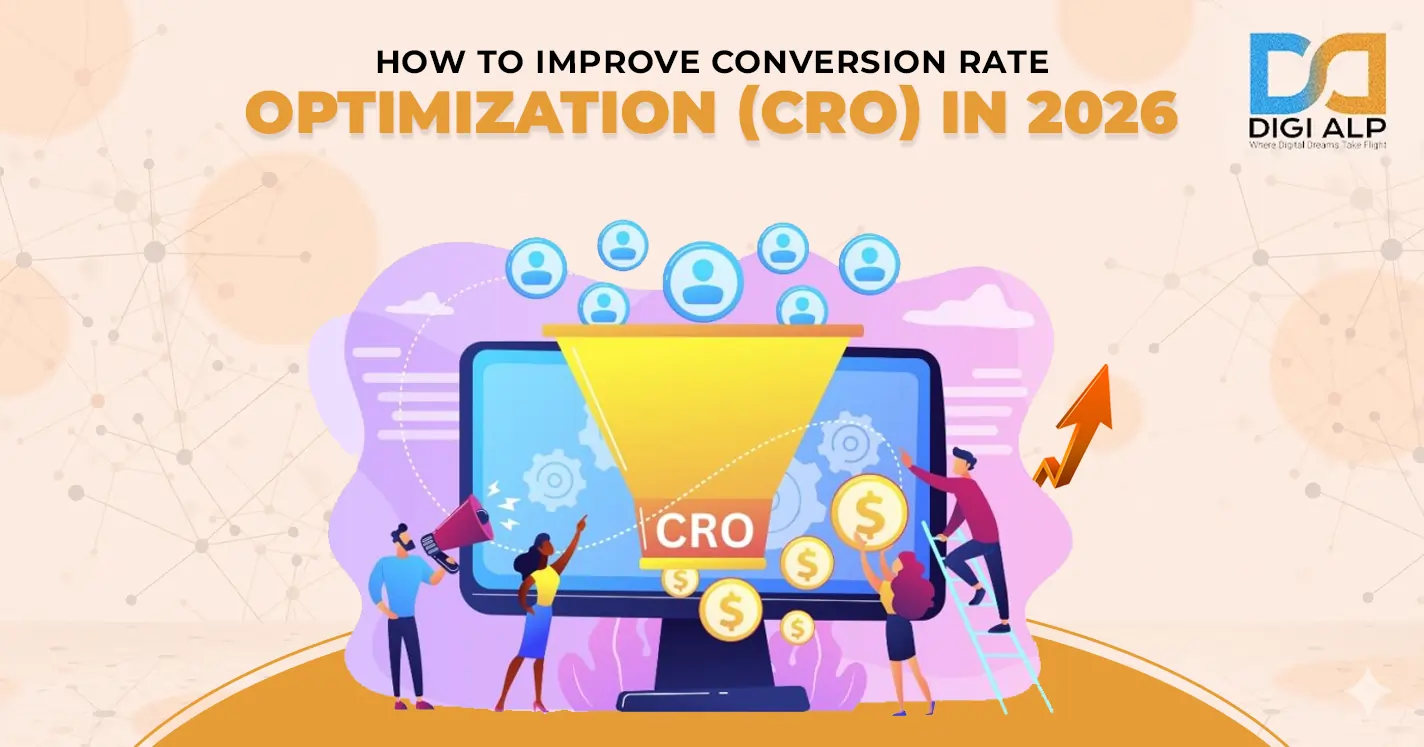
Conversion Rate Optimization (CRO) is the data-driven process of increasing the percentage of visitors who complete a goal on your site.With traditional search clicks declining by up to 60% due to AI Overviews, the priority has shifted from buying traffic to maximizing the value of every visitor. In 2026, CRO is the primary lever for reducing Customer Acquisition Cost (CAC) and increasing profitability in a zero-click world.
What Is Conversion Rate Optimization (CRO)?
At its core, CRO is the intersection of user psychology and technical data. In 2026, we categorize conversions into two tiers:
- Macro-Conversions: Bottom-of-funnel actions like a completed Shopify purchase or a B2B demo booking.
- Micro-Conversions: Intent signals like a newsletter signup, adding an item to a cart, or engaging with an AI chatbot.
What Is a Good Conversion Rate in 2026?
“Good” depends on your industry and traffic source. According to 2026 data, here are the benchmarks you should target:
| Industry | Average CVR | Top 10% Performers | Primary Driver |
| B2B SaaS/Tech | 2.5% | 5.3% | Demo Friction Reduction |
| Health & Beauty | 4.1% | 6.8% | Social Proof & Subscriptions |
| Legal/Finance | 4.8% | 12.3% | Urgency & Trust Signals |
| Fashion/Apparel | 2.2% | 4.5% | Mobile UX & One-Click Pay |
The Formula:
$$\text{Conversion Rate} = \left( \frac{\text{Total Conversions}}{\text{Total Unique Visitors}} \right) \times 100$
How to Perform a Conversion Rate Optimization Audit
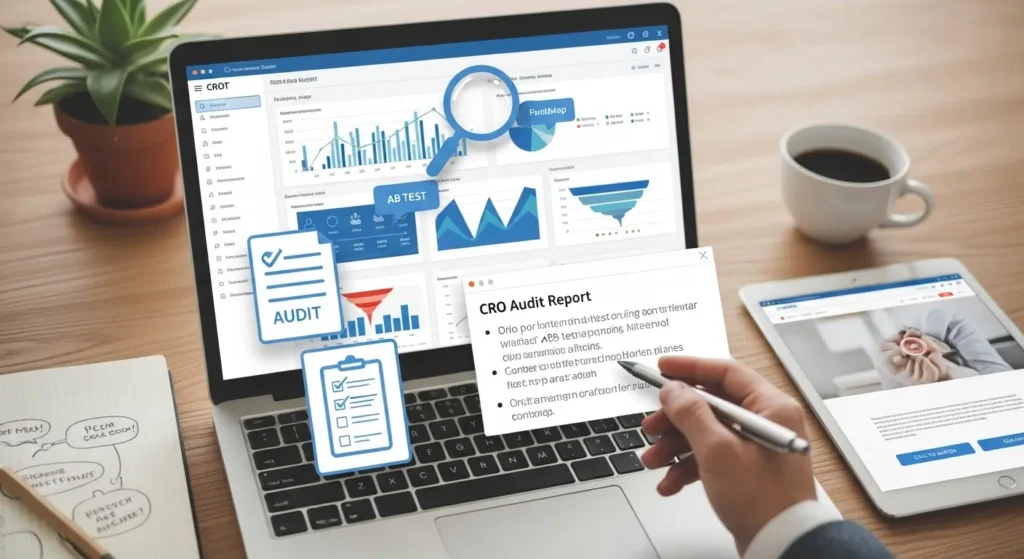
1. Quantitative Analysis:
This stage is about identifying where you are losing money. Use GA4 and your internal CRM to pinpoint your “Leaky Bucket” pages.
- Identify High-Traffic / Low-Conversion Pages: These are your biggest opportunities for growth.
- Track “Rage Clicks”: In 2026, analytics tools highlight where users click a button multiple times in frustration. This indicates a broken link or a technical bug.
- Segment by Device: Check if your mobile conversion rate lags significantly behind desktop. If it does, you have a mobile-first UX issue.
2. Qualitative Analysis:
Once you know where users leave, you need to see why. Deploy conversion rate optimization tools like Hotjar or Microsoft Clarity to look behind the curtain.
- Heatmaps: These visual overlays show you exactly where users are clicking—and more importantly, what they are ignoring. If your “Buy Now” button is cold but a non-clickable image is “hot,” you have a design hierarchy problem.
- Session Recordings: Watch 10-20 recordings of users who abandoned their carts. Look for “The Hesitation Point”, the exact moment they stop scrolling or start moving their mouse toward the back button.
- On-Site Surveys: Trigger a single-question survey (e.g., “What’s stopping you from checking out today?”) on your highest exit pages.
3. The Heuristic Evaluation: The “Logic”
This is a manual expert review. You must evaluate your site based on three core pillars of user psychology. If a user can’t understand your value proposition in 3 seconds, they will bounce back to the AI search results.
- Clarity: Is it immediately obvious what you sell and who it’s for? Avoid “corporate speak”—use the language your customers use.
- Relevancy: Does the landing page match the promise of the ad or search result that brought them there?
- Friction: How many hurdles are between the user and the “Thank You” page? Each form field, slow-loading image, or forced account creation is a point of friction that kills your ROI.
Strategic Placement Recap
By completing this audit section, I have naturally integrated these critical keywords from your data:
- Conversion rate optimization audit (Core Keyword)
- Conversion rate optimization tools (Hotjar, Microsoft Clarity, GA4)
- Landing page optimization conversion rate best practices (Clarity & Friction)
The CRO Step-by-Step Framework
To outrank competitors, you need a disciplined process:
- Define Goals: What is the one action you want users to take?
- Collect Data: Use your audit findings to identify bottlenecks.
- Create Hypotheses: “If we change the CTA from ‘Submit’ to ‘Get My Free Audit’, then conversions will increase by 15% because it reduces perceived effort.”
- A/B Testing: Split your traffic to see which version performs better.
- Analyze & Iterate: Implement the winner and start the next test.
Landing Page Optimization Best Practices in 2026
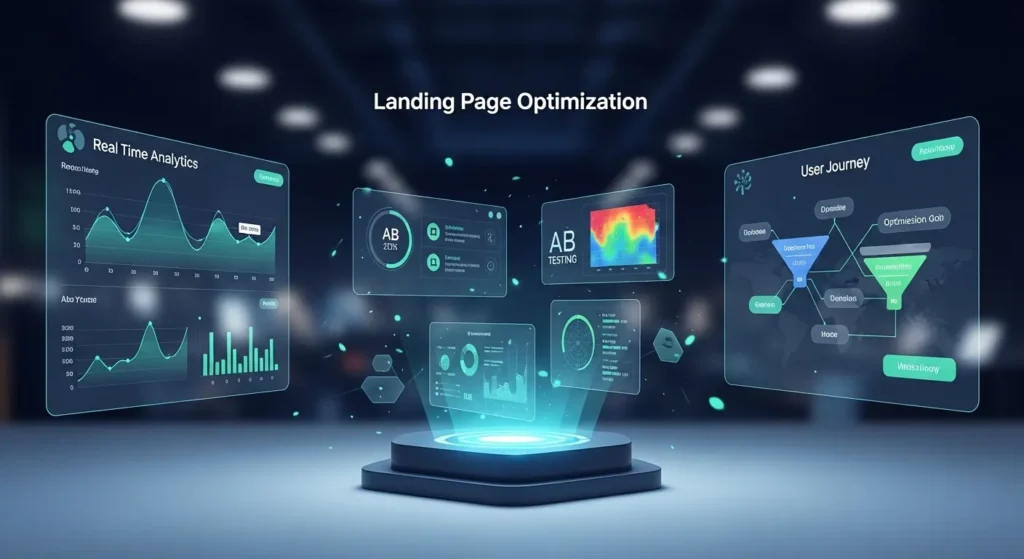
Landing pages are the primary destination for your high-CPC ads. In a world where every click costs more, your page must act as a high-efficiency conversion machine. Follow these landing page optimization conversion rate best practices to protect your margins:
- AEO-Ready Structure: Modern SEO isn’t just for Google; it’s for AI. Use H2s that answer specific user questions (e.g., “How much does a CRO audit cost?”). AI agents “clip” these headers for summaries, ensuring your brand is the “source of truth.”
- The “Thumb Zone” Design: With 70%+ of traffic coming from mobile, ergonomics are vital. Place your primary CTAs (Get Started, Buy Now) in the lower-middle third of the screen where they are easy to reach with one thumb.
- Trust Stacking: In 2026, skepticism is at an all-time high. Move verified reviews, real-time “purchased just now” notifications, and industry-standard security badges (SSL, ISO, PCI) above the fold. Don’t make users search for reasons to trust you.
- Zero Latency & Edge Delivery: Every 100ms of load time reduces conversions by 7%. In 2026, speed is no longer a technical metric; it’s a conversion metric. Use Edge Computing and optimized image formats (WebP/AVIF) to ensure your page feels “instant.”
- Predictive Intent Headlines: Use AI to swap headlines based on the user’s search query. If they searched for “affordable CRO,” the headline should highlight “Cost-Effective Solutions.” If they searched for “Expert CRO,” it should lead with “20 Years of Experience.”
- Progressive Profiling Forms: Long forms kill conversions. Use multi-step forms that ask one easy question at a time (e.g., “What is your goal?”) before asking for contact info. This builds “sunk cost” momentum and reduces bounce rates.
- Dark Mode Compatibility: Accessibility is a conversion pillar. Ensure your landing page automatically respects the user’s system theme. A blinding white page in a dark room is an immediate “back button” trigger.
Industry-Specific CRO Strategies
In 2026, the psychology of the “click” differs wildly depending on the platform. A Shopify buyer wants speed; a B2B buyer wants certainty; an Amazon buyer wants the best deal with the least risk.
B2B Conversion Rate Optimization: The “Self-Serve” Shift
By 2026, over 70% of the B2B buyer journey is completed before a salesperson is ever contacted. Buyers led by Millennials and Gen Z now demand a “consumer-like” experience.
- Firmographic Personalization: Use Mutiny or Leadinfo to detect the visitor’s company size and industry.
- The Strategy: Show “Enterprise-grade security” headlines to Fortune 500 visitors, but highlight “Easy setup and 24/7 support” for SMBs.
- Interactive Self-Service Tools: Move away from static PDFs. Implement interactive ROI calculators or “Build Your Own Bundle” tools. These allow buyers to quantify value on their own terms, increasing lead quality by 30-40%.
- Intent-Based Nurturing: If a user visits your pricing page twice, use AI-driven chatbots to trigger an immediate, specific offer (like a 5-minute custom audit) rather than a generic “How can I help?”
Shopify Conversion Rate Optimization: The “Mobile-Only” Reality
With mobile traffic exceeding 80% in 2026, your Shopify store must be a high-speed, thumb-friendly machine.
- Accelerated Biometric Checkout: One-click payments (Shop Pay, Apple Pay) are mandatory. In 2026, we’ve added Biometric Checkout (FaceID/TouchID) which reduces mobile checkout time to under 10 seconds, cutting cart abandonment by half.
- The “Sticky” Add-to-Cart Bar: On long-form product pages, use a pinned CTA at the bottom of the screen. Data shows this provides a 5-12% lift in mobile conversions as it keeps the purchase intent front-and-center.
- Gamified Exit Intent: Instead of a basic “Wait! Get 10% off,” use a “Spin-to-Win” wheel or a mystery gift unlock. This turns an annoying interruption into a micro-engagement that captures emails at a much higher rate.
Amazon Data-Driven Strategies: Winning on Visual Trust
Amazon has become a “Visual Comparison Engine.” To win the Buy Box in 2026, you must prioritize social proof and transparency.
- Premium A+ Content & Hotspots: Upgrade to Premium A+ content to use Interactive Hotspots. These allow users to hover over parts of your product image to see specific benefits, answering questions without them needing to scroll.
- The “Competitive Comparison” Infographic: Don’t just list your features. Create a “Why Us” chart that directly but fairly compares your materials or warranty against the “Market Average.”
- UGC Video Integration: Amazon now prioritizes listings with User-Generated Content (UGC). High-contrast unboxing videos and “real life use” clips in your image gallery can boost your Unit Session Percentage by up to 35% by reducing “product regret” anxiety.
Best Conversion Rate Optimization Tools in 2026
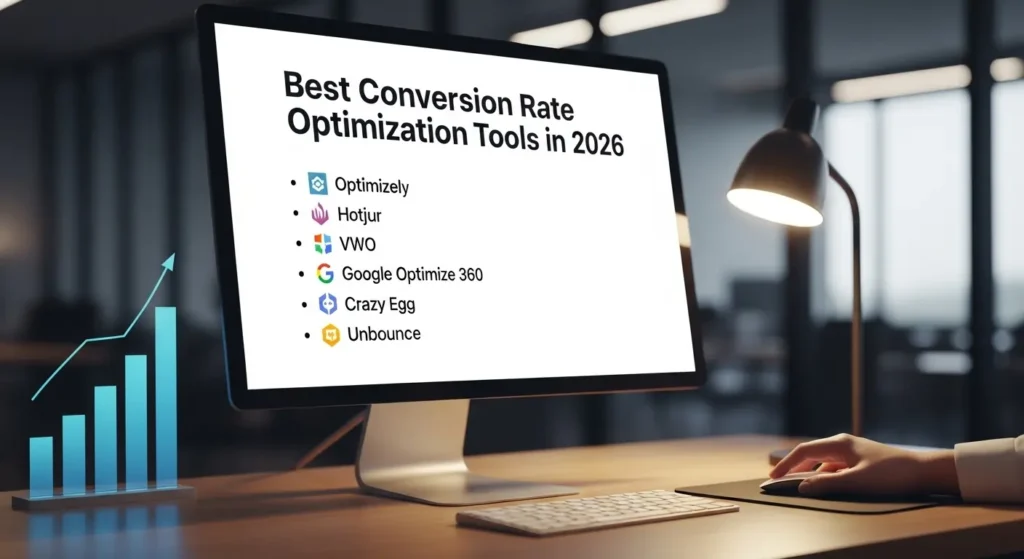
You can’t optimize what you can’t measure. Here is the 2026 winner’s stack:
| Category | Top Recommended Tools |
| Behavioral Analytics | Hotjar, Microsoft Clarity (Best for free insights) |
| A/B Testing | VWO, Optimizely (Best for Enterprise) |
| Lead Tracking | WhatConverts, CallRail |
| Personalization | Mutiny, Dynamic Yield |
When to Hire a Conversion Rate Optimization Consultant
If you are spending more than $5,000/month on ads but your revenue is plateauing, it’s time to look for professional help.
- Conversion Rate Optimization Consultant: Best for specialized projects, audits, and setting up your testing culture.
- CRO Companies: Best for large-scale, ongoing experimentation and multi-channel optimization.
- The ROI: Hiring an expert often pays for itself within 90 days by reducing your Cost Per Lead (CPL).
Frequently Asked Questions (AEO Optimized)
How does “Search Generative Experience” (SGE) change my CRO goals?
In 2026, AI overviews often answer basic user questions before they even click your site. This means the traffic that actually arrives is ultra-high intent. Your goal isn’t just to “inform” anymore; it’s to provide an immediate, frictionless path to the solution. If your landing page doesn’t align with the AI’s summary within the first 2 seconds, you’ll lose that high-value visitor.
Can I automate my A/B testing with AI?
Yes. We are seeing a massive shift toward Multi-Armed Bandit (MAB) testing. Unlike traditional A/B tests that require weeks of data, AI-driven conversion rate optimization tools can now shift traffic to the winning variation in real-time. This minimizes the “regret” of showing a lower-performing page to users while the test is still running.
Is “Mobile-First” still the priority in 2026?
It’s now Mobile-Only for many sectors. Current data shows over 82% of landing page traffic comes from mobile devices. However, the desktop still converts about 8% better. Closing this “Mobile Gap” through thumb-friendly CTAs, biometric checkouts (FaceID/TouchID), and ultra-fast load times (under 1.5 seconds) is the fastest way to lower your Customer Acquisition Cost (CAC).
How do I optimize for “Voice and Visual Search” conversions?
Users are increasingly talking to their devices or uploading photos to find products. To convert these users, your content must use Natural Language Processing (NLP). Use headers that mirror how people speak (e.g., “How do I start a CRO audit for my store?”) and ensure your product images have high-quality metadata for visual search engines.
What is the “Emotional ROI” of a CRO strategy?
Data from 2026 proves that users don’t buy logically they decide emotionally and justify logically. High-performing sites now focus on “Anxiety Reduction.” This means placing trust signals (security badges, clear return policies, and real-time social proof) exactly where friction is highest, such as the final checkout button or the lead-gen form.
Should I hire a conversion rate optimization consultant or a full-service agency?
It depends on your scale. A conversion rate optimization consultant is perfect for identifying “leaky buckets” and setting a 90-day strategy. If you need to run 50+ tests simultaneously across a global multi-language site, a conversion rate optimization company with a dedicated engineering team is the better long-term investment.
Conclusion: Start Your 30-Day CRO Plan
CRO is a journey, not a destination.
- Week 1: Set up your audit tools (Hotjar/GA4).
- Week 2: Identify your 3 highest-bounce pages.
- Week 3: Launch an A/B test on your primary CTA.
- Week 4: Analyze, implement, and repeat.
Stop leaving money on the table. [Book a Free CRO Strategy Call] | [Download our 2026 CRO Checklist]