
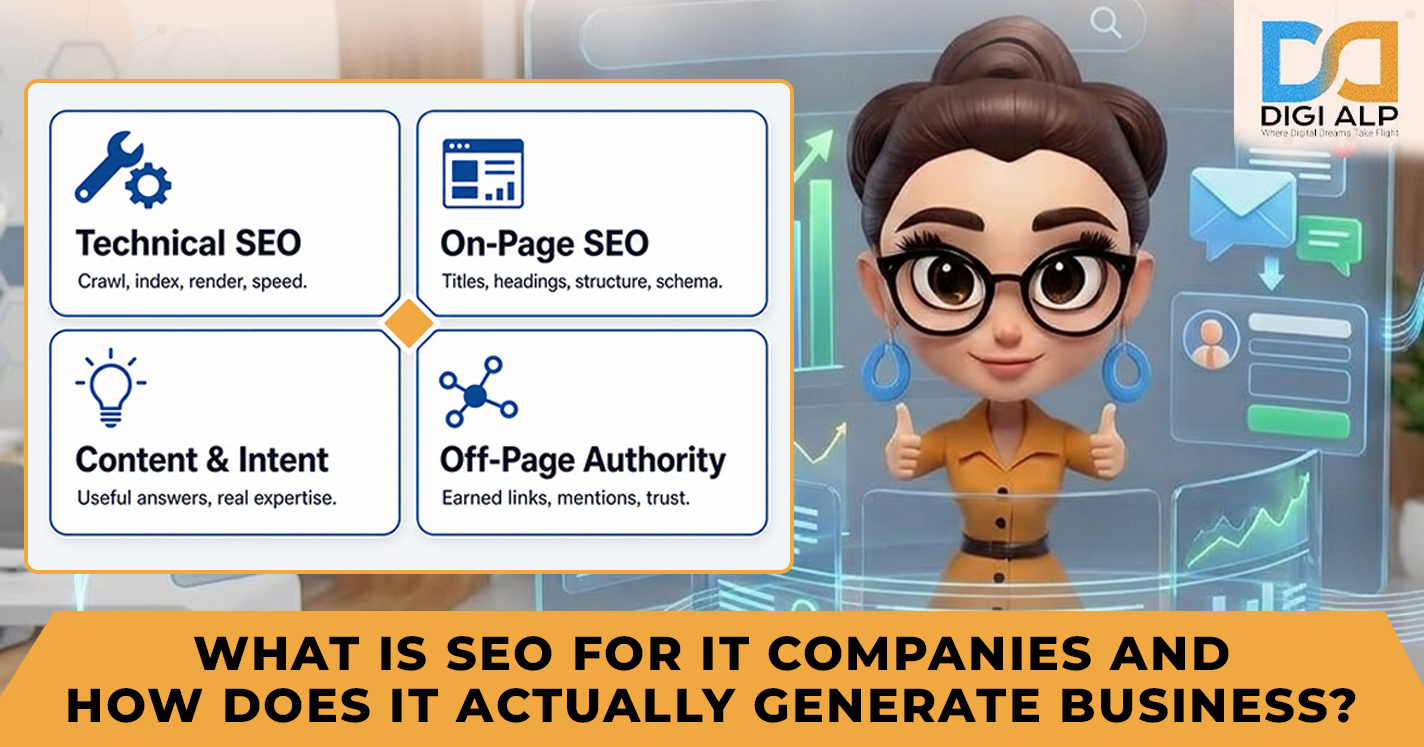
For an IT company, having excellent services is only half the battle. Potential clients need to find your business when they search for software development, IT consulting, web development, cybersecurity, and other technology solutions. This is where SEO for IT companies becomes an important business growth strategy.
Search engine optimization helps IT businesses improve search visibility, attract relevant visitors, generate qualified leads, and turn organic traffic into business opportunities. Unlike paid advertising, which stops producing results the moment a budget runs out, organic search visibility compounds over time a well-optimized service page can keep generating inquiries for years after it’s published, with no ongoing spend per click.
Digi Alp provides search engine optimization solutions built for technology businesses, designed to improve online visibility and support business growth.
What Is SEO for IT Companies?
SEO for IT companies is the process of optimizing an IT business website, content, technical structure, and online presence so its services can appear for relevant search queries. What makes SEO for IT companies distinct from SEO in other industries is the buying process itself: technology purchases are rarely impulsive. A business owner researching a custom software vendor, or an operations manager comparing cybersecurity providers, typically spends weeks reading service pages, comparing capabilities, and checking credibility signals before ever filling out a contact form. SEO has to account for that entire research journey, not just the first click.
For example, an IT company may target searches such as:
- Software development company
- Custom software development services
- IT consulting services
- Web development company
- Mobile app development company
- Cybersecurity services
The goal is not simply to increase traffic. The focus is on attracting people who are looking for services that the business actually provides. A spike in visitors who have no intention of hiring an IT vendor does nothing for revenue it only makes analytics dashboards look busy. Real SEO success for a B2B technology company is measured in qualified conversations, not raw visit counts.
How Does SEO Generate Business?
SEO can support business growth through several key stages, and understanding each one helps explain why SEO is a strategy rather than a single task.
1. Improves Search Visibility
Potential customers often use search engines when they need a technology solution. If an IT company’s website appears for relevant searches, it has an opportunity to reach those potential customers. SEO improves visibility by optimizing website pages around relevant keywords and search intent. This means making sure the page titles, headings, and body content actually reflect the language a buyer would type into Google not just internal jargon the company uses to describe itself. A page that talks about “enterprise digital transformation solutions” may never surface for someone searching “custom software development company,” even though the company offers exactly that service.
2. Attracts Qualified Traffic
Not all website visitors have the same value. SEO focuses on attracting users whose searches match the company’s services. For example, someone searching for “custom software development company” may have a stronger commercial interest than someone searching for a general technology definition like “what is software development.” This makes search intent an important part of an effective SEO strategy. Broadly, search intent falls into a few categories: informational (someone learning a concept), navigational (someone looking for a specific brand), commercial investigation (someone comparing providers), and transactional (someone ready to buy or contact a vendor). An IT company’s SEO strategy should map content to each of these stages, with the most commercially focused pages like service pages built to convert transactional and commercial-investigation traffic specifically.
3. Builds Trust and Authority
IT services often involve significant investment, so potential customers research providers before making contact. Because the decision carries financial and operational risk, buyers look for evidence that a vendor has actually delivered results before, not just claims that they can. At Digi Alp, this stage is supported with documented case studies, transparent reporting, and named client outcomes rather than generic claims the kind of proof points that let a prospect verify credibility before they ever pick up the phone. This is also where technical credibility matters: a well-written article that clearly explains a complex topic does more to build trust than a page that simply lists services with no depth behind them.
4. Generates Leads
SEO becomes more valuable when organic visitors take meaningful actions. Ranking well for a relevant search term is only useful if the page then persuades the visitor to act. An IT website can encourage visitors to:
- Request a consultation
- Submit a project inquiry
- Request a quote
- Book a call
- Contact the sales team
This creates a path from search visibility to potential business. Every page that ranks should have a clear, low-friction next step for the visitor a company that ranks well but buries its contact option behind multiple clicks is leaving organic traffic on the table.
What Makes a Website SEO Friendly
A website needs to be useful for both search engines and visitors. An SEO-friendly site should have a clear structure, fast loading times, mobile usability, descriptive URLs, logical navigation, and well-organized content. Search engines rely on crawling and indexing to understand what a page is about, and a confusing or slow site makes that job harder, which in turn limits how well the page can rank regardless of how good the writing is.
Important elements include:
- Clear website architecture
- Proper heading structure
- Mobile-friendly design
- Fast page performance
- Descriptive URLs
- Internal linking
- Optimized images
- Clear calls to action
IT companies should also create dedicated pages for important services rather than placing every service on one general page. A single “Services” page that briefly mentions software development, cybersecurity, cloud consulting, and mobile app development all in a few paragraphs each cannot compete against a competitor who has built a focused, in-depth page for each of those services individually. Dedicated pages also make it easier to match specific search intent, since each page can be written around the exact language a buyer of that particular service would use.
Core SEO Practices for IT Companies
Effective SEO requires more than adding keywords to a page. Some of the practices that matter most right now include:
Match Content With Search Intent
Understand whether users are looking for information, comparing services, or ready to contact a provider. Create content that directly matches their intent. A blog post explaining “what is custom software development” should educate, while the service page for “custom software development services” should sell mixing the two purposes on one page usually weakens both.
Optimize Service Pages
Service pages should clearly explain what the company offers, who it serves, its capabilities, and how potential customers can get started. A strong service page typically answers four questions in order: what the service is, why it matters to the visitor’s business, how the company delivers it differently from competitors, and what the visitor should do next.
Create Useful Content
Publish content that answers real customer questions and demonstrates industry expertise. This is where an IT company’s technical staff can become a genuine SEO asset the engineers, consultants, and architects who already answer client questions every day are also the best source of material for content that ranks, because it reflects real expertise instead of generic marketing language.
Improve Technical SEO
Regularly check crawlability, indexing, page speed, mobile usability, broken links, redirects, and website architecture. Technical SEO issues are easy to overlook because they don’t show up in the content itself a page can be perfectly written and still fail to rank if search engines can’t crawl it properly or if it loads too slowly on mobile devices.
Build Relevant Internal Links
Connect related service pages and articles to help users navigate the website and help search engines understand the site’s content structure. Internal linking also distributes authority across a site a well-linked service page benefits from the credibility of the blog content that links into it, and vice versa.
Tools for Measuring SEO Performance
Website optimization tools help businesses measure performance and identify areas for improvement. Without measurement, SEO becomes guesswork a company might assume a page is underperforming when the real issue is simply that it hasn’t been indexed yet, or assume a page is doing well when its traffic is actually irrelevant to the business. These tools can provide information about:
- Keyword rankings
- Organic traffic
- Search queries
- Backlinks
- Technical SEO problems
- Competitor performance
- Page performance
Google Search Console and Google Analytics can help monitor search visibility and website activity, while platforms such as Semrush and Ahrefs provide additional keyword and competitor research capabilities. Search Console in particular is useful because it shows the exact queries a site is already appearing for, even ones the company never deliberately targeted often revealing opportunities that weren’t part of the original keyword strategy.
The important part is using this data to improve the website and SEO strategy rather than simply collecting reports. A monthly report that isn’t tied to a specific action updating a page, fixing a technical issue, publishing new content doesn’t move the needle on its own.
Technical SEO and IT Websites
Technical SEO helps search engines crawl, understand, and index a website effectively. For an IT company, technical SEO can include:
- XML sitemaps
- Indexation
- Canonical URLs
- Page speed
- Mobile usability
- Structured data
- Broken links
- Redirects
- Website architecture
A technically healthy website provides a stronger foundation for content and search visibility. It’s worth noting that technical SEO issues tend to compound: a slow-loading service page not only frustrates visitors but can also reduce how deeply search engines crawl the rest of the site, meaning technical problems on one page can quietly hold back the performance of pages elsewhere.
Turning Technical Knowledge Into Content
IT companies have valuable technical knowledge that can be turned into useful search-focused content. Topics can include:
- Software development costs
- Custom software development
- IT consulting
- Mobile app development
- Cloud solutions
- Cybersecurity
- Software development processes
Content should provide genuine value while naturally connecting readers to relevant services. A well-written article on software development costs, for instance, can walk through the factors that typically influence pricing project scope, technology stack, team location, and maintenance requirements without needing invented figures, and can then naturally point the reader toward a consultation if they want a project-specific estimate.
SEO and Conversion Optimization
Generating organic traffic is only one part of the process. The website also needs to convert relevant visitors into leads. Visitors may leave when a page has unclear messaging, weak calls to action, poor navigation, or does not explain the service properly. Two companies can rank in the exact same position for the same keyword and generate very different amounts of business, simply because one page converts visitors more effectively than the other.
SEO and conversion optimization work best together, which is why Digi Alp pairs its SEO work with dedicated conversion rate optimization support rather than treating traffic growth and lead generation as separate problems.
How IT Companies Can Build an SEO Strategy
A practical SEO strategy can follow these steps:
- Research keywords based on relevance, search intent, competition, and business value.
- Map keywords to pages so each important search intent has an appropriate destination.
- Optimize on-page elements including titles, headings, content, URLs, images, and internal links.
- Fix technical SEO issues that affect crawling, indexing, or performance.
- Create useful content around customer questions and service-related topics.
- Build relevant authority through quality backlinks, partnerships, case studies, and digital PR.
- Measure performance using organic traffic, rankings, leads, and conversions.
Following these steps in order matters. Building content before fixing technical issues, for instance, often means well-written pages struggle to get indexed at all the foundation has to be solid before the content built on top of it can perform.
Common SEO Mistakes IT Companies Should Avoid
Focusing only on traffic. High traffic does not necessarily mean high-quality leads. Business relevance should remain a priority over raw visitor counts.
Ignoring service pages. Service pages are often closer to the buying stage and should receive proper SEO attention, rather than most of the effort going into blog content.
Publishing unrelated content. Blog topics should connect with the company’s target audience and services, rather than chasing broad, unrelated search volume.
Keyword stuffing. Using keywords excessively can make content difficult to read. Keywords should be incorporated naturally, in a way that still reads well to an actual person.
Neglecting technical SEO. Technical problems can prevent search engines from properly accessing and understanding important pages, no matter how good the content itself is.
Conclusion
SEO for IT companies is about more than achieving higher search rankings. It helps connect technology businesses with potential customers who are actively searching for relevant solutions, at the exact moment they’re deciding who to work with.
A strong strategy combines keyword research, a technically sound and user-friendly website, useful content, optimized service pages, analytics, and conversion optimization. None of these elements works well in isolation a technically perfect site with no useful content won’t convert, and great content on a slow, poorly structured site won’t even get found.
When these elements work together, organic search can become a sustainable channel for attracting relevant visitors and generating business opportunities one that keeps producing results long after the initial work is done.
To build a structured SEO strategy for your IT business, explore Digi Alp’s SEO services.
Frequently Asked Questions
What is SEO for IT companies?
It’s the ongoing process of aligning an IT business’s website, technical setup, and content with how buyers of software development, consulting, or cybersecurity services actually search — so the company shows up at the moment a prospect is evaluating providers, not just when they’re browsing definitions.
How does SEO generate business for IT companies?
It works in a chain: visibility gets the right person to the site, relevant content and case studies build enough trust for them to consider the company seriously, and a clear call to action converts that trust into a sales conversation.
Why does a website’s technical health matter for SEO?
Search engines can only rank pages they can crawl, render, and understand quickly. Slow load times, broken internal links, or a confusing site structure waste crawl budget and push otherwise strong content further down the results so technical fixes often unlock faster gains than new content does.
What should an IT company prioritize going forward? Search intent matching, well-built service pages, internal linking that reflects the site’s real topic clusters, and genuine expertise signals matter more than chasing a fixed yearly checklist, since ranking factors shift continuously.
Which tools are useful for tracking SEO performance?
Google Search Console and Google Analytics for first-party visibility and behavior data, and platforms like Semrush or Ahrefs for keyword gaps, backlink audits, and competitor tracking.
How long does SEO take to generate results?
It’s a long-term channel. Timelines vary with competition, existing site authority, technical condition, content quality, and the consistency of the work most IT companies see meaningful movement over months, not weeks.