
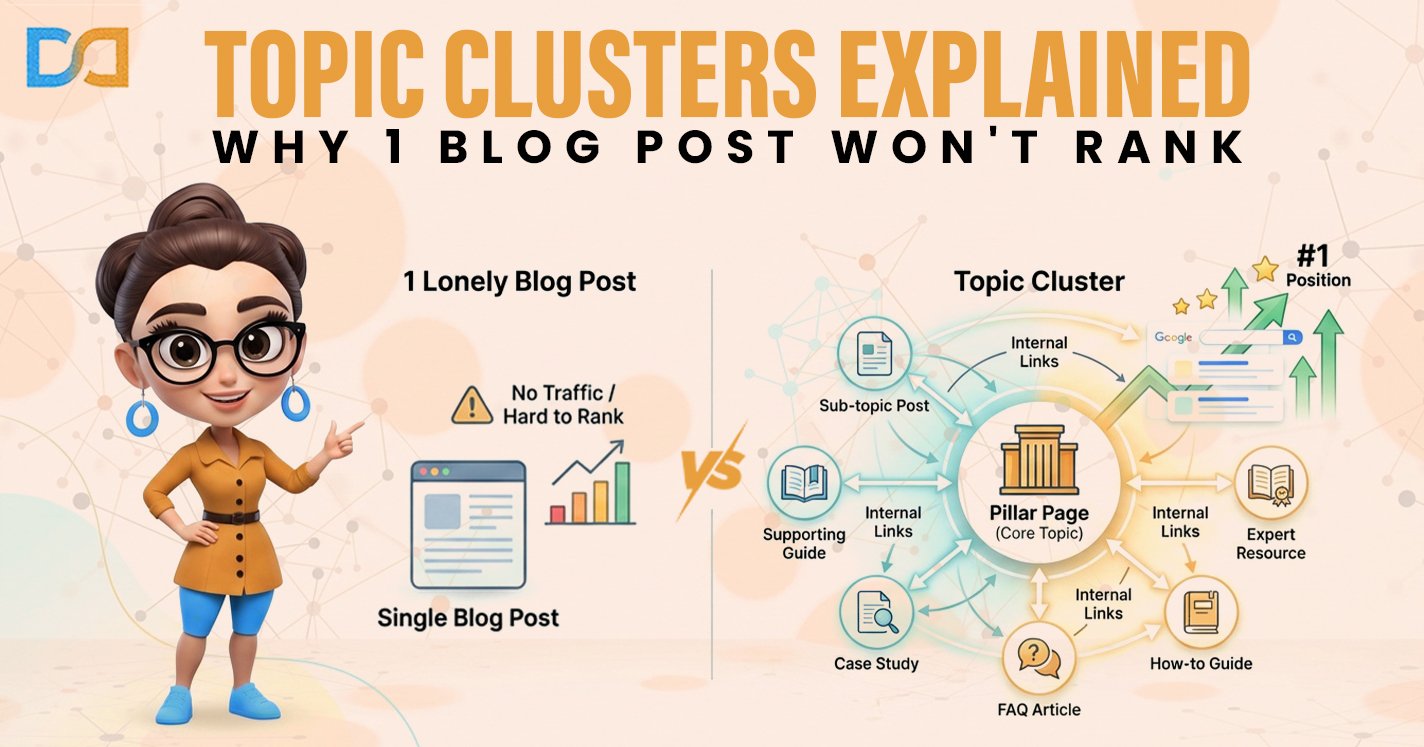
Publishing one blog post about an important business topic does not automatically make your website an authority on that subject. A single article may rank for a focused search query, but it often cannot answer every related question a potential customer has.
That is where topic clusters SEO becomes valuable.
A topic cluster connects one comprehensive pillar page with several supporting articles that explore specific aspects of the same subject. Together, these pages create a structured content experience that helps readers discover useful information and helps search engines understand how your website’s content relates.
Instead of publishing disconnected articles and hoping one performs, businesses can build a connected library of resources around the topics their customers care about.
This guide explains how pillar-and-spoke content works, why it matters, and how to create an SEO topic cluster strategy that supports long-term organic visibility.
What Are Topic Clusters in SEO?
Topic clusters in SEO are groups of closely related website pages organized around one central subject, with internal links connecting the main pillar page to supporting articles.
A typical topic cluster has three components:
1. Pillar page: The main resource that explains a broad subject and introduces its important subtopics.
2. Cluster or spoke articles: Supporting pages that answer specific questions in greater detail.
3. Internal links: Contextual links that connect the supporting articles to the pillar and, where useful, to other related articles.
For example, a digital marketing agency could build a content cluster around content marketing:
- Pillar: Content Marketing for Small Businesses.
- Spoke 1: How to Build a Content Calendar.
- Spoke 2: Topic Clusters Explained.
- Spoke 3: Content Repurposing Strategies.
- Spoke 4: How to Measure Content Marketing ROI.
- Spoke 5: Content Pillars Explained.
- Spoke 6: How to Conduct a Content Audit.
- Spoke 7: Question-Shaped Content for Search.
The pillar introduces the overall strategy, while each supporting article addresses a specific search question.
Why Is One Blog Post Often Not Enough to Build Topical Coverage?
One blog post may answer a specific question, but it usually cannot explore every related problem, comparison, implementation step, and customer concern in sufficient detail.
Imagine a small business publishing an article about SEO. It covers keyword research, technical SEO, backlinks, local search, and content optimization in a few paragraphs.
The article may introduce useful concepts, but someone looking for detailed keyword research instructions or a local SEO checklist still needs more information.
A cluster solves this problem by giving each important subtopic its own dedicated resource.
The benefits include:
- Broader search coverage: Separate pages can target different relevant search queries and intents.
- Better user navigation: Readers can move from introductory information to more detailed answers.
- Clearer content relationships: Internal links connect related resources.
- Greater subject depth: Your website can demonstrate practical knowledge across important areas.
- More conversion opportunities: Supporting articles can guide readers toward relevant services and next steps.
However, topic clusters are not a guaranteed Google ranking factor. A single excellent article can rank independently, and publishing more related pages does not automatically improve rankings.
The goal is to provide useful, distinct coverage rather than manufacture content simply to increase page count.
How Do Pillar Pages and Topic Clusters Work Together?
Pillar pages and topic clusters work together by dividing a broad subject into a central guide and focused supporting resources.
The pillar provides the overview. Supporting articles answer questions that deserve more explanation.
Consider a small web development company targeting businesses interested in website development.
Its pillar page might cover website development costs, planning, technologies, maintenance, and project requirements.
Its supporting articles could explore:
- Website development cost by project type.
- Custom website versus template-based development.
- Website maintenance requirements.
- How to choose a web development company.
- Website security considerations.
- Website performance optimization.
The pillar should link to relevant supporting articles, and each spoke should link back to the pillar using descriptive anchor text.
This creates a logical navigation structure for visitors and helps search engines discover related pages.
For more context on organizing content around business goals, read DigiAlp guide tocontent marketing for small business.
How to Build an SEO Topic Cluster Strategy
A practical SEO topic cluster strategy begins with one business-relevant subject, identifies distinct search questions, assigns each question to the right page, and connects the resulting content through internal links.
Follow these five steps.
Step 1: Choose a Business-Relevant Pillar Topic
Start with a subject that directly connects to your products, services, and customer problems.
Avoid choosing a topic simply because it has a large search volume.
For example, an accounting company might select small business bookkeeping as its central topic because potential customers regularly need help understanding financial records and bookkeeping processes.
The subject should be broad enough to support multiple useful articles but focused enough to remain relevant to the business.
Step 2: Research Supporting Keywords and Questions
Identify the questions people ask about the main topic, including informational, comparison, and commercial searches.
Use keyword research tools, Google Search Console, competitor analysis, customer conversations, and search suggestions to identify opportunities.
Group keywords by search intent rather than placing every related keyword into a separate article.
DigiAlp guide tofinding the right keywords for your business provides additional guidance for this stage.
Step 3: Assign One Clear Purpose to Each Article
Give every page a distinct purpose so your articles do not compete with one another for the same search intent.
For example, a cluster about email marketing could include:
| Page | Main purpose |
| Email Marketing Guide | Explain the complete subject |
| Email Automation | Explain automated campaigns |
| Email Segmentation | Explain audience grouping |
| Newsletter Strategy | Explain regular email content |
| Email Performance | Explain campaign measurement |
This structure reduces unnecessary overlap and makes the content easier to plan.
Step 4: Create and Interlink the Pages
Publish a comprehensive pillar page and supporting articles that offer useful, independent answers.
Use descriptive internal links wherever another page provides meaningful additional information.
Avoid inserting links just to increase the number of internal links. Each connection should help readers understand a related subject or take a relevant next step.
Google’s internal linking best practices recommend descriptive anchor text and contextual connections between related pages.
Step 5: Review and Expand the Cluster
Review the cluster periodically using organic search queries, page performance, customer feedback, and content gaps.
Look for unanswered questions, outdated explanations, pages with overlapping intent, and articles that receive impressions but do not attract relevant clicks.
Expand the cluster only when a new page provides distinct value.
What Are the Common Topic Cluster SEO Mistakes?
The biggest topic cluster mistakes are creating unnecessary articles, targeting overlapping keywords, using weak internal links, and prioritizing quantity over usefulness.
Watch out for these problems:
Creating articles just to fill a cluster: Seven nearly identical pages do not create meaningful topical coverage.
Keyword cannibalization: Multiple pages targeting the same search intent can make it harder to establish which page best serves the query.
Weak pillar content: A short overview that simply lists supporting articles does not provide enough value as a central resource.
Missing internal links: Publishing related pages without connecting them makes content discovery less intuitive.
Ignoring search intent: An informational question needs a useful explanation, not an aggressively promotional service page.
Never updating content: New information, changing customer needs, and better resources may require revisions to existing pages.
Remember that a cluster is an editorial structure, not a ranking shortcut. Google’s people-first content guidance emphasizes useful, reliable content that genuinely serves readers.
How Do You Measure Topic Cluster Performance?
Measure topic cluster performance by evaluating the pillar and its supporting pages together, while also reviewing each page’s individual contribution.
Use Google Search Console to monitor:
- Impressions and clicks across relevant search queries.
- Search visibility of individual cluster pages.
- Average position trends for target queries.
- Pages receiving impressions but few clicks.
Use Google Analytics 4 to review:
- Organic landing-page activity.
- Engagement with important resources.
- Navigation between related articles.
- Contact form submissions and other relevant conversions.
Also examine whether readers move from informational articles toward service pages.
DigiAlp Data Intelligence Services can support reporting and performance analysis across marketing channels.
Do not judge a cluster only by its total traffic. A smaller cluster attracting relevant visitors and qualified inquiries may be more valuable than one generating large amounts of unrelated traffic.
Frequently Asked Questions About SEO Topic Clusters
1. How many articles should a topic cluster have?
There is no fixed number. A cluster may start with one pillar and three useful supporting articles, then expand as genuine content opportunities emerge. Prioritize coverage and quality over reaching an arbitrary article count.
2. Do topic clusters directly improve Google rankings?
Topic clusters are not a guaranteed or officially designated Google ranking factor. They help organize useful content, support internal discovery, and cover related search needs. Rankings still depend on relevance, quality, competition, technical accessibility, and other factors.
3. What is the difference between a pillar page and a topic cluster?
A pillar page is the main comprehensive resource about a broad topic. A topic cluster is the complete group of the pillar and its supporting articles, connected through relevant internal links.
4. Can small businesses benefit from topic clusters?
Yes. Small businesses can start with one important service topic and a few supporting articles. This makes content planning more focused and helps businesses build useful resources without publishing randomly.
5. Should every blog post belong to a topic cluster?
No. Some articles can serve standalone purposes, answer timely questions, or support specific campaigns. Cluster articles are most useful when their relationship to a central business topic is clear.
Ready to find content gaps and organize your website around the topics your customers search for?
Request a Content Audit from Digi Alp. Identify overlapping pages, missing supporting topics, internal linking opportunities, and improvements to your existing content structure.
Book a consultation