
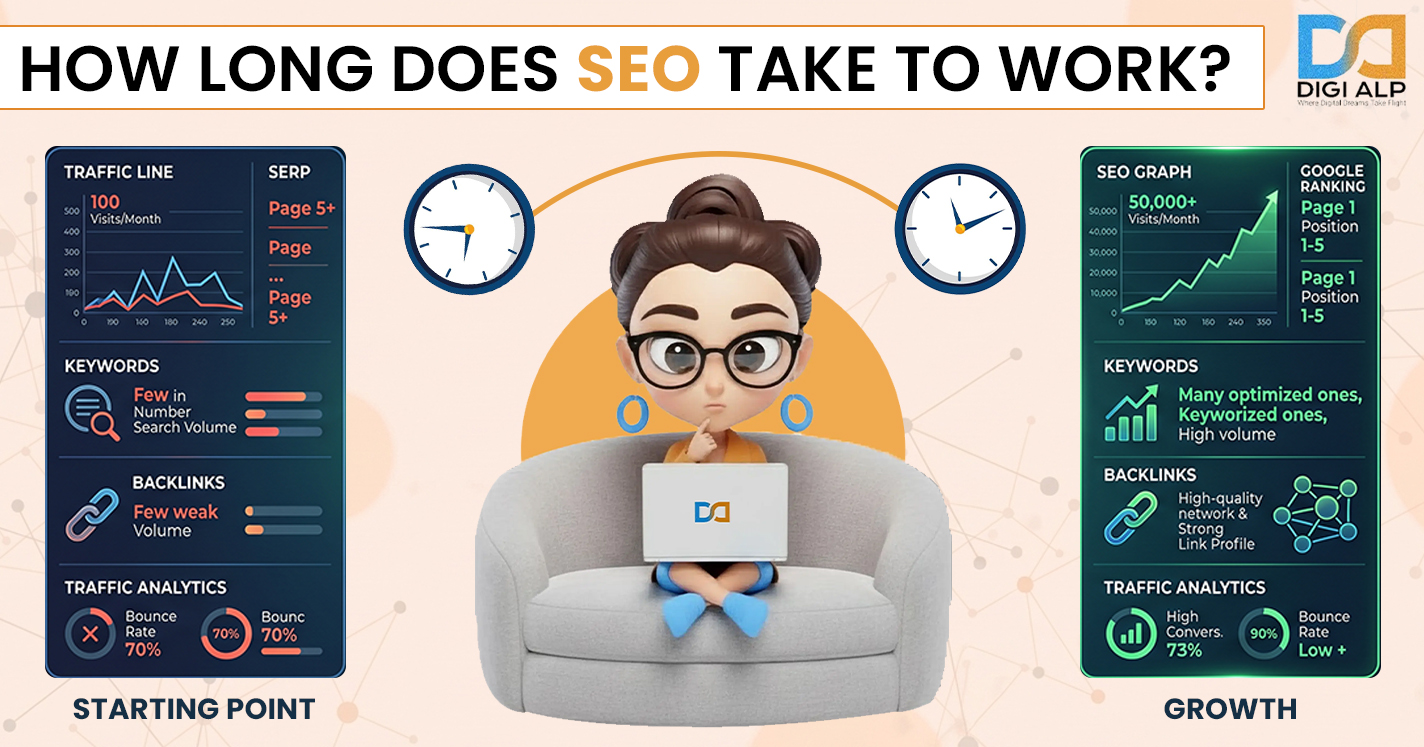
Most websites see early movement (indexing, impressions, long-tail rankings) within 1-3 months and meaningful organic traffic within 3-6 months. Rankings for competitive keywords usually take 9-12 months or more. New domains and competitive industries sit at the longer end of these ranges.
Google’s own documentation points the same way: it suggests expecting four months to a year from the time you start making changes.
That range is wide because no two websites start from the same place. A local plumber with a clean site faces a very different road than a new SaaS brand competing with established players. This guide explains what shapes the timeline, what you should see at each stage, and how to avoid the mistakes that quietly add months. If you would rather start with a structured plan, you can explore DigiAlp’s SEO services.
SEO Timeline at a Glance
These are typical industry ranges. Your results depend on your starting point and your competition.
| Scenario | Early signs | Real traction |
| Local business, low competition | 1-2 months | 3-4 months |
| Established site with existing authority | 1-2 months | 3-6 months |
| New website | 2-3 months | 6-9 months |
| Competitive niche (finance, SaaS, legal) | 3-4 months | 9-12+ months |
“Early signs” means more indexed pages, rising impressions and first long-tail rankings. “Real traction” means steady growth in organic clicks and enquiries.
Treat these numbers as planning ranges, not promises. A site with serious technical problems can sit below the table for a long time, while a site with strong existing authority and a few quick fixes can beat it.
Why SEO Is Slower Than Paid Ads
Paid ads buy visibility the day a campaign goes live. SEO has to earn it. Search engines must crawl your pages, understand what they cover, compare them with competing pages and gradually decide whether they deserve to rank.
An Ahrefs study of nearly 2 million pages found that only about 5.7% of newly published pages reached the top 10 within a year. That sounds discouraging, but it mostly shows how many pages are published without a clear strategy, a real search audience or any authority behind them.
The upside is that SEO compounds. A page that ranks keeps sending visitors without a cost for every click, which ads cannot do. If you need traffic immediately while organic growth builds, paid ads can cover the gap in the meantime.
The SEO Timeline, Month by Month
Month 1: Audit and Foundations
The first month is mostly diagnosis. It covers crawlability, indexing, page speed, site structure, existing content and the backlink profile. Keywords are then mapped to search intent and compared against what competitors already rank for.
This stage matters more than it looks. Fixing a blocked or non-indexed page can improve visibility faster than any new content, so the audit often decides how quickly everything after it moves.
What you may see: little change in traffic, but better indexing and a clear priority list.
Months 2-3: Fixes and First Content
Technical fixes go live: metadata, internal linking, broken links, redirects and page structure. New and updated pages target keywords you can realistically win, usually long-tail and lower-competition terms first.
Long-tail searches are the natural starting point. They have fewer competitors, clearer intent and often convert better, so they give a young campaign its first proof of progress.
What you may see: rising impressions, first long-tail rankings, and some fluctuation in positions. That movement is normal and not yet a verdict on results.
Months 3-6: Momentum
By now, technical improvements, content and internal links have accumulated. Search engines have enough signals to start ranking your pages higher, and Search Console usually shows the shift clearly: more queries, more impressions and a steadier climb in clicks.
What you may see: more keywords in the top 20, growing organic clicks, and commercial pages starting to appear. This is the point to start tracking leads and conversions, not just rankings.
Months 6-12 and Beyond: Compounding Growth
Authority builds, older pages mature, and competitive keywords become reachable. An Ahrefs study found the average page ranking #1 is over two years old, so the best-performing content often keeps improving long after launch.
SEO is not a project that ends at month six. Competitors publish, algorithms change and content goes stale, so the work becomes ongoing: refreshing pages, adding topics and earning links. Sites that stop at the first sign of success usually watch their gains fade.
What Determines How Fast SEO Works?
Six factors explain most of the variation between websites.
- Domain age and authority. Established sites with quality backlinks start from a stronger position. A new domain has to build credibility from zero, though age alone guarantees nothing. An old site with thin content and no links has little advantage.
- Keyword competition. A long-tail phrase like “emergency plumber in Karachi” can rank in weeks. A national keyword like “car insurance” can take a year or more. Choosing winnable targets first is the single biggest lever on your timeline.
- Technical health. Crawl errors, slow pages and poor structure can cancel out good content. Fixing them is often the fastest win because it removes obstacles instead of adding new work.
- Content quality and intent match. Pages must answer what the searcher actually wants. A page that is well written but built around the wrong intent will struggle, and keyword-stuffed content rarely moves up at all.
- Backlinks. A few relevant, high-quality links outweigh many weak ones. Earn them through useful resources, original research, digital PR and genuine partnerships rather than bulk link buying.
- Consistency. A site that publishes and optimises every month will outpace one that does a burst of work and stops. Slow progress is often a sign that recommendations were never implemented.
How Long Does SEO Take for a New Website?
Plan for 6-9 months before steady traction, and longer in competitive niches. A new site has no history, no authority and no backlinks, so search engines have little to judge it on. Even a perfectly built site needs time to be crawled, understood and trusted.
The first weeks are about getting the basics right: a clean structure, a submitted sitemap, fast pages and a small set of well-targeted pages instead of dozens of thin ones.
Instead of asking “when will we reach #1?”, track these milestones:
- Pages are indexed correctly (weeks 1-4)
- Impressions appear for relevant queries (months 1-3)
- Long-tail keywords start ranking (months 2-4)
- Organic clicks grow steadily (months 3-6)
- Visitors turn into enquiries or sales (months 4-9)
If you are hitting these in roughly this order, the campaign is healthy even if the traffic still looks small.
How Long Does SEO Take for an Established Website?
Usually 3-6 months, and often faster for quick wins. Existing pages already have impressions, links and history, so improving a service page that ranks on page two can produce results sooner than writing a new one from scratch.
The catch: older sites often carry outdated content, thin pages, duplicate URLs and technical debt, which the audit needs to clear first. Cleaning this up can feel slow because the early work is invisible to visitors, but it creates the base that later gains depend on.
Location-based businesses often see shorter timelines. Local searches have fewer competing pages, and signals like a complete Google Business Profile, consistent business details and genuine reviews can lift visibility within a few months.
Why Some SEO Campaigns Take Longer
Expect the longer end of the range when:
- The domain is new or has little authority
- Competitors are large, established brands
- The site has serious technical issues
- Content does not match search intent
- The backlink profile is weak
- Agreed recommendations are not implemented
The last point is the most common and the most avoidable. Many campaigns stall not because the strategy was wrong, but because fixes sat in a queue for months. Even a modest plan delivers more than a brilliant plan that never goes live.
How to Speed Up SEO Results
No one can guarantee rankings by a date, and anyone who does is a red flag. What you can do is prioritise the work that moves results fastest, and a structured SEO plan helps keep that order clear.
- Fix technical blockers first. Indexing and crawl issues are the fastest wins.
- Target realistic keywords. Win long-tail terms first, then build toward harder ones.
- Update pages that already get impressions. A page sitting on positions 8-20 often needs only a better title, stronger content and more internal links.
- Strengthen internal linking. It helps both users and crawlers reach your key pages.
- Build relevant links. Quality beats quantity every time.
- Implement quickly. A good strategy delivers nothing until it is live.
Be careful with anything that promises instant rankings. Tactics like mass-produced content, purchased links or hidden text may create a short spike, but they carry a real risk of penalties and usually cost more time than they save.
Common Mistakes That Delay Results
A few habits add months to almost any timeline:
- Judging results too early. Checking rankings daily and reacting to every dip leads to constant strategy changes. Review monthly instead.
- Chasing volume over intent. A keyword with fewer searches but strong buying intent is often worth more than a high-volume term that attracts casual browsers.
- Publishing without a plan. Random articles on unrelated topics build little authority. Group content around a few core topics so each page supports the others.
- Ignoring existing pages. Teams often write new content while their best older pages sit half-optimised.
- Stopping too soon. Many sites quit around month four, right before the compounding effect begins.
How to Tell If SEO Is Working
Measure progress in layers, because rankings alone are misleading:
| Layer | Metric | When it usually moves |
| Visibility | Impressions, indexed pages | Months 1-3 |
| Traffic | Organic clicks, landing-page traffic | Months 3-6 |
| Engagement | Pages per visit, time on page | Months 3-6 |
| Conversions | Leads, calls, bookings, sales | Months 4-9 |
| Revenue | Organic revenue, cost per acquisition | Months 6-12 |
Use Google Search Console for impressions and clicks, and GA4 for conversions. Review monthly, not daily. Daily ranking changes are mostly noise.
With AI Overviews changing how people click through search results, clicks and rankings alone no longer tell the full story. Track impressions and conversions alongside them, and watch whether the visitors who do arrive are the right audience for your business.
Final Thoughts
SEO has no fixed finish date, but it follows a realistic pattern: early signs in 1-3 months, steady traction in 3-6, and competitive rankings in 9-12+. New websites should plan for 6-9 months, while established and local sites often move faster.
Your timeline depends on authority, competition, technical health, content quality, backlinks and how consistently you implement. The sites that get there fastest fix technical blockers first, target winnable keywords, improve pages that already earn impressions, and measure progress through impressions, clicks, leads and revenue instead of rankings alone.
Patience matters, but patience alone is not a strategy. If you want a clear plan for your own site, talk to DigiAlp’s SEO team for a timeline based on your domain, competition and goals.
FAQs
How long does SEO take to work?
Most sites see early signs in 1-3 months and real traction in 3-6 months. Competitive keywords and new domains can take 9-12 months or more.
Can SEO work in one month?
You can see early signals in a month, such as better indexing, more impressions and first long-tail rankings. Significant traffic and leads rarely arrive that fast.
How long until a new website ranks on Google?
Typically 6-9 months to reach steady traction. The first 2-3 months focus on indexing, technical setup and long-tail content.
Why is my SEO not working after 6 months?
Common causes are unresolved technical issues, content that misses search intent, a weak backlink profile, strong competition or unimplemented recommendations. An audit usually shows which one applies.
Should I use SEO and paid ads together?
Yes, if you need fast traffic now and long-term organic growth. Ads cover the gap while SEO builds momentum.
How do I know if SEO is working?
Track impressions and clicks in Search Console first, then leads and revenue in GA4. If impressions and long-tail rankings are rising by months 2-3, you are on track.