
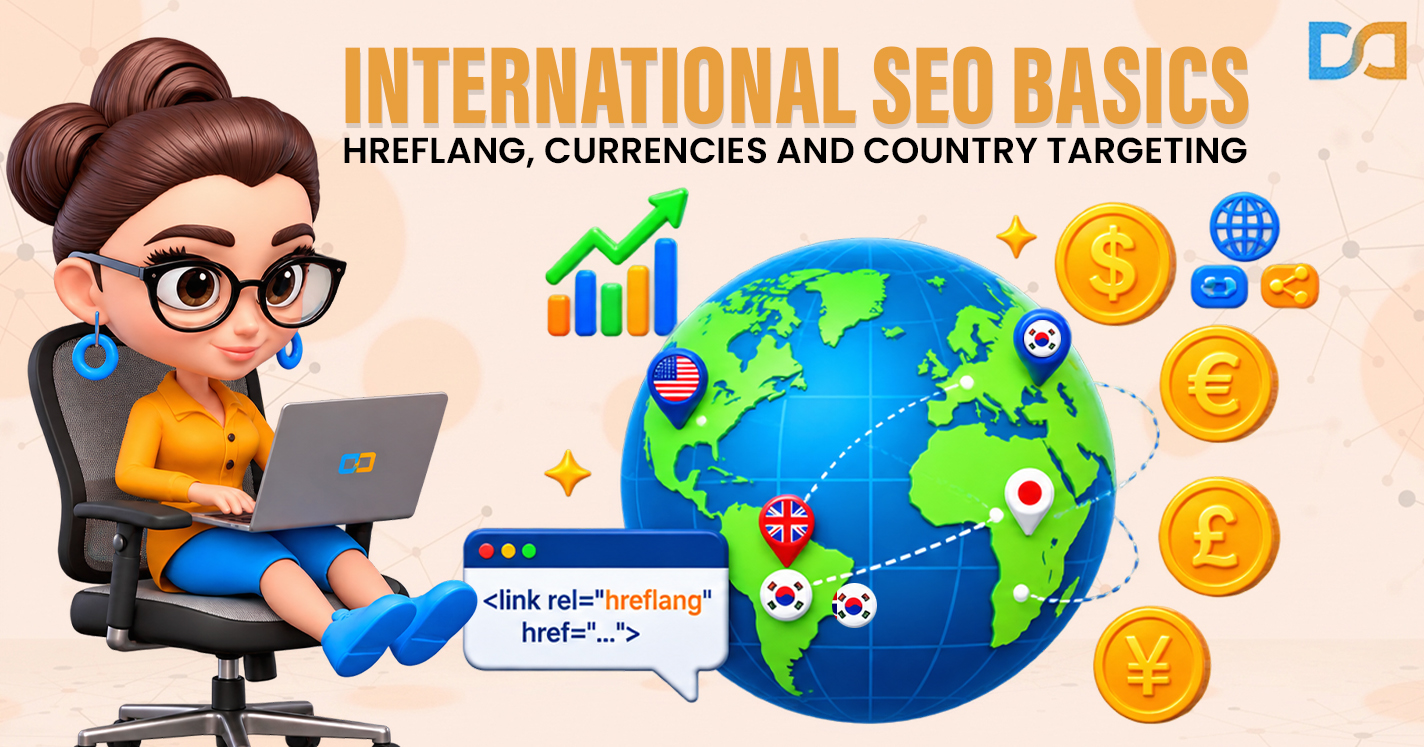
Selling products internationally requires more than accepting orders from different countries. Your ecommerce website must help search engines understand which pages serve which audiences, while giving international shoppers relevant product information, language options, and pricing.
This is where international SEO hreflang becomes important. Hreflang connects equivalent pages intended for different languages or regions. Currency localization helps customers understand prices, while country-specific URL structures and localized content provide additional market signals.
Without proper planning, an online store can create confusing page variations, inconsistent prices, and competing URLs.
This guide explains how to implement hreflang, organize international website versions, handle multiple currencies, and follow practical international SEO best practices without creating unnecessary complexity.
1. What Is International SEO and Why Does Hreflang Matter?
International SEO is the process of optimizing a website to reach customers in different countries and languages. Hreflang helps search engines understand which localized version of a page is intended for a particular language or regional audience.
Consider a Pakistani exporter selling products to customers in the United States and United Kingdom.
The store might have:
- An English version for US customers.
- An English version for UK customers.
- A German version for customers in Germany.
Although some pages may contain similar product information, their prices, shipping details, spelling, and purchasing conditions might differ. Hreflang identifies these related versions so Google can understand their intended audiences.
It is an important part of the broader ecommerce SEO for exporters strategy, but it does not replace keyword research, product-page optimization, or localized content. One important distinction: hreflang does not automatically translate pages, guarantee indexing, or improve rankings by itself.
2. How Does Hreflang Tags Implementation Work?
Hreflang tags implementation involves adding alternate-language or regional references to equivalent pages so search engines can identify the correct version for users. For example, a store selling the same product in the USA and UK might use:
- en-US for English-speaking US customers.
- en-GB for English-speaking UK customers.
- x-default for visitors without a matching language or regional version.
A simplified HTML implementation looks like this:
<link rel=”alternate”
hreflang=”en-US”
href=”https://example.com/en-us/product/” />
<link rel=”alternate”
hreflang=”en-GB”
href=”https://example.com/en-gb/product/” />
<link rel=”alternate”
hreflang=”x-default”
href=”https://example.com/product/” />
These annotations should be implemented consistently across the equivalent pages.
Important implementation rules:
- Every localized page should reference itself and its alternate versions.
- Alternate pages should reference one another using reciprocal hreflang annotations.
- Use valid language and country codes.
- Point to complete, indexable URLs.
- Keep canonical tags consistent with each page’s intended canonical URL.
For language and region codes, use ISO standards. For example, en-GB is correct for English in the United Kingdom. The region code alone, such as GB, is not a valid hreflang value.
Google supports three implementation methods: HTML tags, HTTP headers, and XML sitemaps. Choose the method that best fits your website architecture rather than duplicating all three without a management reason.
Read Google’s official localized versions documentation for implementation examples and common errors.
3. How Should an International Store Handle Multiple Currencies?
An international ecommerce store should display clear, consistent pricing in the currencies relevant to its customers, while ensuring that product data, landing pages, and checkout information agree.
For example, a Pakistani exporter selling to customers in the USA and UK might display USD prices for American shoppers and GBP prices for British shoppers. However, currency switching alone does not create a separate international SEO strategy.
Consider these requirements:
Display understandable prices: Make the currency obvious instead of showing an ambiguous price such as 100 without identifying whether it is USD, GBP, or another currency.
Keep checkout consistent: Explain whether customers will be charged in their displayed currency or whether their payment provider will convert the amount.
Maintain accurate product data: Product structured data can use the priceCurrency property with a three-letter ISO 4217 currency code, such as USD, GBP, or EUR.
Keep product feeds consistent: If you use Google Merchant Center, check that product prices, landing-page prices, and shipping information follow the applicable target-country requirements.
For further technical guidance, see Google’s Product structured data documentation and Merchant Center currency guidance.
Digi Alp also explains how structured data for online stores helps search engines interpret product prices, availability, and other product information.
Remember that currency is primarily a purchasing and localization consideration. Changing a displayed price from USD to GBP does not, by itself, tell Google that a page targets the United Kingdom.
4. How Does Country-Specific SEO Targeting Work?
Country-specific SEO targeting helps search engines understand which markets your website serves through localized URLs, relevant content, language information, and other regional signals.
There are three common website structures:
| Structure | Example | Best suited for |
| Country-specific domain | example.co.uk | Businesses with separate country domains |
| Subdomain | uk.example.com | Separate regional website environments |
| Subdirectory | example.com/en-gb/ | Centralized international website management |
Each structure has advantages.
Country-specific domains provide a clear country association but require additional domain management. Subdomains can support separate regional operations, while subdirectories make it easier to manage international content under one main domain.
For businesses expanding into several markets, subdirectories can be a practical starting point.
However, URL structure alone is not enough.
Your localized pages should also reflect actual market requirements, including:
- Country-specific product availability.
- Relevant shipping and delivery information.
- Local spelling and terminology.
- Appropriate currency and payment information.
- Market-specific product descriptions.
- Relevant contact and customer support details.
Avoid automatically redirecting every visitor based only on IP address or browser language. Search engines may not discover every version if users and crawlers cannot access the URLs directly.
Instead, provide a visible country and language selector so visitors can choose their preferred experience.
Google’s guide to managing multi-regional and multilingual websites explains the available targeting signals and common implementation mistakes.
5. International SEO Best Practices: A Practical Implementation Checklist
The most effective international SEO best practices combine technical implementation with meaningful localization and regular testing.
Use this checklist before launching additional country versions:
Step 1: Select priority markets
Identify countries based on actual product demand, existing customer relationships, shipping capabilities, competition, and business resources.
Step 2: Research local search behavior
Do not assume customers use the same search phrases everywhere. Research country-specific keywords and purchasing terminology before creating localized product pages.
Step 3: Build a consistent URL structure
Choose country domains, subdomains, or subdirectories based on your operational requirements. Give each important language or regional version its own crawlable URL.
Step 4: Implement hreflang correctly
Create reciprocal annotations, use valid language-region codes, and include the appropriate default version where needed.
Step 5: Localize product information
Adapt product descriptions, currencies, shipping details, measurements, and customer-facing information to the actual target market.
Step 6: Review technical SEO
Check canonical tags, indexability, internal links, XML sitemaps, and product structured data.
Step 7: Monitor performance by country
Use Google Search Console to review impressions, clicks, indexing problems, and search visibility by country. Use analytics to understand product inquiries, orders, and conversions.
Digi Alp search engine optimization services can support technical audits, international page optimization, and ongoing search performance reviews.
For businesses expanding into multiple markets,digital marketing services and SEO-driven content marketing can also help coordinate regional content and audience acquisition.
6. Common International SEO Mistakes to Avoid
International SEO problems often occur when businesses create multiple country versions without properly managing the relationships between their pages.
Watch out for these common mistakes:
- Missing reciprocal hreflang: One regional page references another, but the second page does not link back.
- Incorrect country codes: Using invalid region values or country codes without language codes.
- Duplicate localized pages: Publishing nearly identical pages without meaningful market-specific information.
- Inconsistent pricing: Showing different prices in product feeds, landing pages, and checkout.
- Incorrect canonical tags: Pointing localized pages toward an unrelated regional version.
- Automatic redirects: Preventing users and search engines from accessing other regional versions.
- Targeting too many countries: Creating market pages without confirming demand, shipping capabilities, or commercial value.
The solution is not to create a separate version for every country. Start with the markets your business can realistically serve and expand as demand justifies the investment.
Frequently Asked Questions
Does hreflang prevent duplicate content?
Hreflang helps Google understand relationships between equivalent language or regional pages. It is not a duplicate-content prevention mechanism. Use appropriate canonical tags and make sure each localized version provides a useful experience.
Do I need hreflang if my website only uses English?
Not necessarily. If your website has only one English version for all markets, hreflang may not be needed. It becomes useful when you have genuinely distinct regional or language versions, such as US English and UK English pages.
Does changing website currency improve international rankings?
Changing currency alone does not establish country targeting or guarantee better rankings. Currency localization improves pricing clarity and purchasing convenience. Combine it with appropriate URLs, localized content, and other regional signals.
Should I use subdomains or subdirectories for international SEO?
Both can work. Subdirectories are often easier to manage centrally, while subdomains and separate country domains can suit businesses with different regional operations. Choose based on your technical resources and market strategy.
How many countries should an ecommerce website target?
Start with the countries where you have realistic product demand, competitive opportunities, and the ability to fulfill orders. Expand gradually rather than creating regional pages for markets your business cannot properly serve.
Ready to improve your international ecommerce visibility?
Request an ecommerce SEO audit from Digi Alp and identify the opportunities and technical gaps affecting your target markets.
Request a Audit