
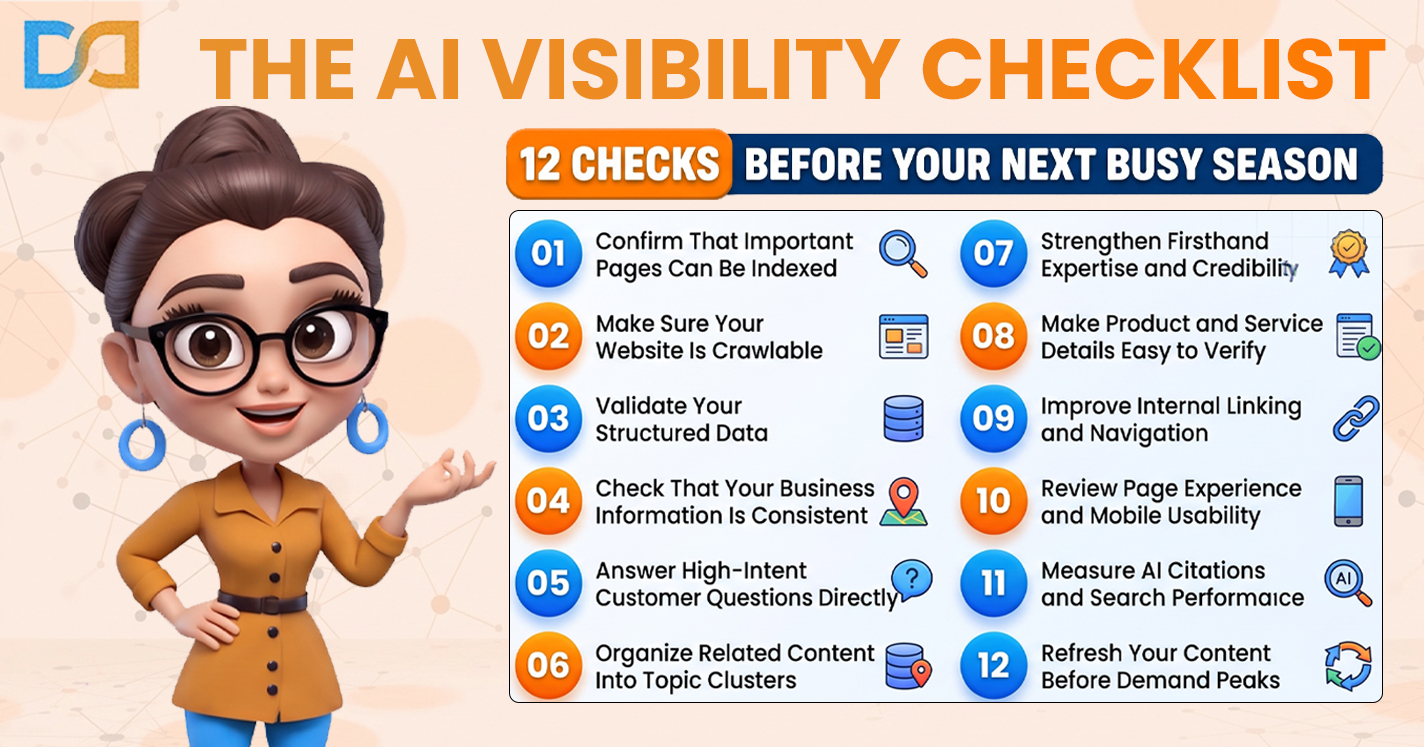
Before your next busy season, your website should be easy for search engines to discover, understand, and evaluate. An effective AI visibility checklist helps you identify technical barriers, unclear content, missing business information, and credibility gaps that could limit your chances of appearing in AI-generated search answers.
Whether you are preparing for holiday shopping, a product launch, a seasonal service rush, or a major sales campaign, complete these 12 checks before demand increases. The goal is not to guarantee an AI citation. It is to make your website more accessible, useful, and trustworthy for search systems and potential customers.
Use the checklist to prioritize problems that affect your most valuable pages first.
The AI Visibility Checklist: 12 Essential Checks
1. Confirm That Important Pages Can Be Indexed
Your most valuable pages must be accessible to search engines before they can become reliable sources for search results. Review your homepage, service pages, product categories, important landing pages, and seasonal campaign content.
What to check:
- Inspect priority URLs using Google Search Console’s URL Inspection tool.
- Confirm that important pages are not blocked by robots.txt.
- Check for accidental noindex directives.
- Review canonical tags for incorrect destinations.
- Submit an updated XML sitemap when necessary.
Example: If your holiday gift guide is published but excluded from indexing, its useful recommendations may not be available through ordinary search discovery.
Do not assume that a URL is indexed simply because it loads in your browser.
2. Make Sure Your Website Is Crawlable
Indexing checks are not enough if crawlers encounter inaccessible pages, broken links, or important content hidden behind technical barriers. Review the routes that allow search systems to discover your content.
Check internal links, redirects, server errors, and mobile accessibility. Confirm that important information appears in the rendered page rather than depending entirely on interactions that some crawlers may not process reliably.
Also distinguish between search engine crawlers and AI-related crawlers. Their access rules and behavior can differ by platform. Review your server logs and relevant access policies where practical.
Action: Fix repeated errors on commercially important pages before spending time on minor technical issues.
3. Validate Your Structured Data
Structured data gives search engines explicit information about the entities and content represented on a page. It can help clarify products, organizations, services, articles, and other supported content types.
Review relevant schema types, such as Organization, Product, Article, BreadcrumbList, or LocalBusiness, where appropriate.
Confirm that:
- The markup matches visible page content.
- Product prices and availability are accurate when included.
- Required properties are present for the selected schema type.
- Markup passes the relevant validation tests.
- Outdated or contradictory schema is removed.
Structured data does not guarantee inclusion in AI-generated answers. Treat it as a clarity and eligibility improvement, not a shortcut to citations.
4. Check That Your Business Information Is Consistent
AI-assisted discovery can involve interpreting information from multiple sources. Inconsistent business names, addresses, service descriptions, or contact details can make it harder for customers to verify which information is correct.
Review your website’s About, Contact, service, and location pages. Compare key details with your business profiles and other authoritative listings.
For example, if your website lists one service area while your business profile lists another, resolve the discrepancy and explain your actual coverage clearly.
For online businesses, consistency also includes company naming, product identifiers, support information, and return policies where relevant.
5. Answer High-Intent Customer Questions Directly
Useful content answers the question a customer actually has instead of forcing them to search through several paragraphs. Review the questions prospects ask before purchasing, booking, or contacting your team.
For each priority page, identify the main question and answer it near the beginning. Follow with supporting details, limitations, examples, and next steps.
For instance, a software company might answer, “How long does implementation take?” with a realistic explanation of the factors that affect delivery time.
Avoid vague introductions that delay the answer. Do not invent guarantees or timelines simply to sound authoritative.
6. Organize Related Content Into Topic Clusters
A collection of connected pages can explain a subject more completely than disconnected articles. Build a clear relationship between your main resource, supporting articles, and relevant service pages.
Start with your central topic, then identify specific questions that deserve separate coverage. Link the pages naturally using descriptive anchor text.
For example, DigiAlp AI search optimization pillar provides broader guidance, while this checklist focuses on practical readiness checks before a busy season.
Avoid publishing several articles that target essentially the same question. Each page should have a distinct purpose and offer information that genuinely adds value.
7. Strengthen Firsthand Expertise and Credibility
Content is more useful when readers can assess who created it, why it should be trusted, and whether its recommendations are grounded in real knowledge.
Review author information, company credentials, editorial standards, and supporting evidence. Where appropriate, include original examples, product demonstrations, expert explanations, or documented processes.
Cite reliable sources for claims that require evidence. Keep dates, names, prices, and technical details current.
Do not manufacture testimonials, customer results, qualifications, or research findings. Unsupported claims may weaken trust rather than improve visibility.
8. Make Product and Service Details Easy to Verify
Before peak demand, ensure that customers can quickly understand what you offer and whether it meets their needs.
For service pages, clarify deliverables, intended customers, process, limitations, and next steps. For ecommerce pages, review product specifications, pricing, availability, shipping, returns, and relevant compatibility information.
Use descriptive headings and readable text rather than relying exclusively on promotional graphics.
If a product is unavailable or a service has changed, update the relevant page promptly. Contradictory information across product pages, FAQs, and policies creates avoidable uncertainty.
9. Improve Internal Linking and Navigation
Internal links help visitors and search crawlers move between related resources. They also make it easier to understand how individual pages relate to your broader expertise.
Check that important seasonal landing pages receive relevant links from existing articles, category pages, and navigation where appropriate.
Use meaningful anchors such as “AI search visibility measurement” instead of repeatedly using generic phrases like “click here.”
Link to supporting resources when they help answer the reader’s next question. Remove broken links and avoid adding unrelated links simply to increase the total number of links on a page.
10. Review Page Experience and Mobile Usability
A technically accessible page still needs to work well for people. Before traffic increases, test your most important pages on mobile and desktop.
Review loading performance, layout shifts, intrusive pop-ups, readability, navigation, and form functionality. Make sure essential content is visible without excessive interaction.
Test important conversion journeys, including product selection, quote requests, booking forms, and checkout.
A faster, clearer experience supports users and can help broader search performance, but no particular page-speed score guarantees AI visibility.
11. Measure AI Citations and Search Performance
You cannot improve what you never evaluate. Establish a baseline before making major seasonal changes, then monitor conventional search performance and AI visibility separately.
Create a list of realistic customer prompts related to your brand, services, products, and industry. Check whether relevant AI search experiences mention your business, cite your pages, describe your offerings accurately, or recommend competitors instead.
Record the platform, prompt, date, cited URL, and whether the result was relevant. AI-generated responses can vary, so avoid drawing conclusions from one observation.
For a repeatable process, use DigiAlp guide to measuring AI search visibility to track citations and changes over time.
12. Refresh Your Content Before Demand Peaks
Outdated information can undermine an otherwise useful page. Before your busy season, review the content customers are most likely to find and use.
Check seasonal offers, product availability, pricing, service coverage, dates, examples, statistics, and external references. Update screenshots or instructions when the product or process has changed.
Add new information only when it improves the page. Rewriting an entire article merely to change its publication date does not automatically make it more valuable.
Practical rule: Prioritize pages with high commercial value, outdated information, declining performance, or strong relevance to upcoming customer demand.
What Should You Fix First?
If you discover multiple issues, prioritize them by impact rather than trying to fix everything simultaneously.
- Resolve access barriers: Fix blocked, broken, or incorrectly excluded priority pages.
- Correct misleading information: Update outdated business details, prices, availability, and claims.
- Improve important content: Answer customer questions and strengthen weak or incomplete pages.
- Clarify relationships: Add relevant internal links and organize related content.
- Validate and measure: Check structured data, establish an AI citation baseline, and monitor changes.
Technical problems that prevent discovery deserve attention before cosmetic improvements. Afterward, focus on the pages most likely to help customers make informed decisions.
For a coordinated approach, DigiAlp search engine optimization services can support technical reviews, content improvements, and broader organic search priorities.
Turn Your Checklist Into a Pre-Season Action Plan
An AI visibility checklist works best when every issue has an owner, a priority, and a clear completion status. Record each check in a simple spreadsheet with the affected URL, problem, recommended fix, responsible person, and review date.
Complete critical technical fixes first, then address content and credibility gaps. Recheck priority pages after changes are published, and continue monitoring citations during the season.
Remember that AI search systems differ in how they discover, select, and cite sources. No checklist can guarantee that your business will appear in every answer. However, improving accessibility, factual consistency, useful content, and trust gives you a stronger foundation for discovery.
Preparing for your next busy season?
Request a Free Visibility Check from DigiAlp to identify opportunities to improve your website’s AI search readiness and organic visibility.
Request your free visibility check