
Healthcare startups devote substantial time and effort to building products and services, websites, technology, and brands that make them stand out. However, one crucial element many healthcare startups tend to overlook during their growth is content that addresses the questions their target patients are asking. A well-planned healthcare content strategy can help startups turn their expertise into useful, trustworthy information that attracts, educates, and supports the right audience.
A healthcare website has to do more than introduce the services your startup provides and convince visitors of their value. More importantly, it must help your target audience make informed decisions, choose between different options, find the information they seek, and feel supported throughout the process. This is where the need for a strategic healthcare content strategy emerges.
The objective is not to publish dozens (or even hundreds) of articles about health-related topics. Instead, healthcare startups should create content topics that help patients make decisions, establish trust, and differentiate the startup from competitors by educating patients on what the company does differently and why it matters.
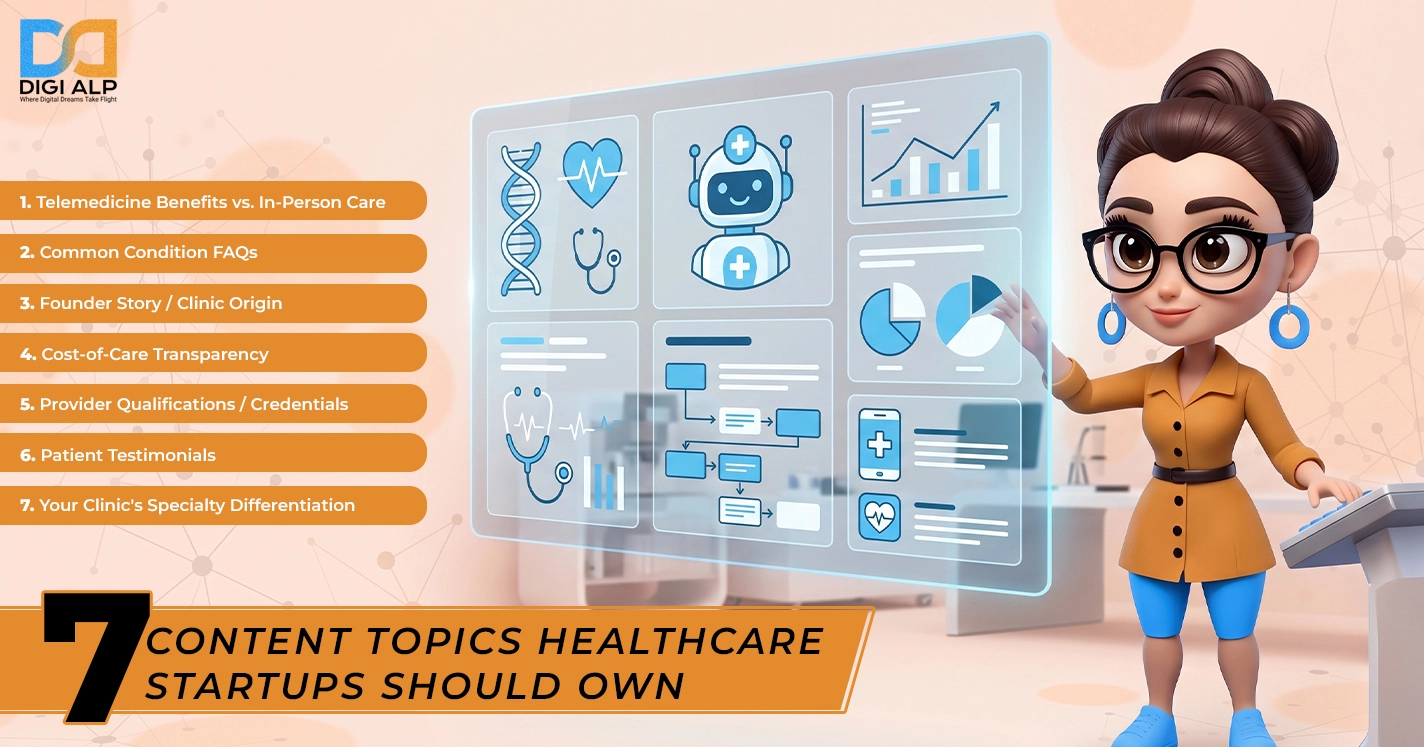
Below are 7 Content Topics Healthcare Startups should invest time and effort into creating to strengthen their online presence, educate patients, and stand out from competitors.
1. Telemedicine Benefits vs. In-Person Care
While telemedicine has changed the healthcare landscape for many patients, patients may be unsure about what conditions are most suitable for a virtual or an in-person appointment.
This presents a content opportunity by addressing some of the most common concerns.
Instead of merely writing a post about telemedicine, healthcare startups can offer a more comprehensive view of the service by creating a list of what telemedicine and in-person appointments would entail.
It is a beneficial type of post to make because it targets patients who are considering making an appointment.
- What the post could include:
- An overview of what patients can expect from telemedicine
- Reasons why it could be a good choice for them
- How an in-person appointment may be a more suitable alternative based on their needs
- How a follow-up appointment would operate
- What they should consider when deciding on how to make an appointment
- What questions they should ask prior to making an appointment.
This would allow patients to make a more educated choice about how to book an appointment rather than promoting one particular option.
Why This Content Matters
Someone reading about the differences between telemedicine and in-person care is likely searching for information pertaining to a question they have or a medical choice they are deliberating.
This makes such content valuable both in terms of the patient’s learning journey, as well as its ability to improve visibility through healthcare SEO.
Healthcare startups may additionally benefit from being able to organically tie telemedicine and in-person care into their services, availability, and providers. With this in mind, the question of telemedicine in comparison to an in-clinic visit becomes a valuable resource for a healthcare startup’s blog, as it can enrich the experience of a patient who is considering making an appointment.
2. Common Condition FAQs
Before they decide to contact a medical provider, patients frequently research health concerns online.
They may be looking for an overview of potential issues, clarification on some symptoms, details regarding further action, or questions to ask their physician. For this reason, common condition FAQs represent one of the most valuable post types for a clinic blog topics.
By focusing on the conditions pertinent to their specialization and the services they offer, healthcare startups can provide the information that patients will find useful and direct them to the appropriate pages.
A condition FAQ may include:
- The definition and description of the condition
- The list and description of common symptoms
- Known causes and risk factors
- When to reach out to a medical professional
- What to expect from the diagnostic process
- Questions to ask one’s physician
- What to know about the condition that isn’t obvious
Why FAQs Are Valuable
The format of the FAQ allows patients to find the information they need without having to sort through unrelated content. Patients frequently stumble upon a healthcare startup’s blog, and the presence of an article catering to their specific needs and answering their questions may encourage them to revisit the page and explore other entries.
This is the point at which patient education content into a tool for lead generation for healthcare startups, as engaging content can prompt further action ranging from contacting the clinic to signing up for a newsletter. The information on the page, however, should always be considered from the perspective of a patient – a healthcare startup’s blog is a patient education resource and should not offer diagnostic services. With this in mind, proper medical review of the information on the page should always be a priority.
3. Founder Story / Clinic Origin
Patients want to know about the services a healthcare organization provides, but they also want to know who is providing them and why.
Founder story / clinic origin copy can be used to explain this.
Many healthcare websites focus mostly on services, availability, and biographies with little look into the background or reasons for founding the organization.
Founder story or clinic origin copy can provide:
- Why the organization was founded
- What problem the founder wanted to solve
- What inspired the organization to be formed
- How the mission statement came to be
- What principles the organization was founded upon
- How the organization has evolved since its founding
Building Trust Through the Story
The goal is not to make it appear as a promotional biography, rather explain the reasoning behind starting a healthcare practice in a way that makes the most sense to patients.
For instance, the founder might discuss an experience which made him or her realize a need for this particular type of care or wanted to provide a different patient experience.
This can give patients an idea as to what the organization is all about.
If there are several similar healthcare organizations in one area, this can also serve as a differentiator and provide patients with more to connect with regarding the clinic or hospital.
This is especially true for healthcare startups, as the story behind the company can be the basis for its differentiation from other similar companies.
4. Cost-of-Care Transparency
Cost is important to patients, however, understanding it can be challenging due to the complexity of healthcare billing.
Healthcare startups have the opportunity to take on a more transparent approach to cost of care by providing more straight forward answers regarding cost of services they offer.
Depending on the type of healthcare services the organization offers, it might not be possible to provide a generalized idea about its cost due to the number of factors involved in billing, cost, and patient responsibility.
Transparency does not mean stating a cost for each procedure, rather explaining what the clinic can provide in terms of billing and cost information.
This could include:
- What is covered in a particular service or consultation
- What factors may influence the cost for certain services
- Information about payment options
- Insurance related information
- Availability of estimating the cost
- Questions patients may have regarding cost
- Where patients can find current cost information
Transparency Builds Patient Confidence
Patients should not be put in the position of figuring out the financial aspects of care on their own.
Having this information readily available and easy to find on the website can provide patients with greater clarity and help them get the care they need.
This can also be the sign of a well-meaning healthcare startup which recognizes the value of being transparent with cost and financial information in order to help patients make well-informed decisions about their health.
However, the language and information should reflect realistic expectations and should also follow any billing and financial guidelines the organization is required to follow.
It is all about providing clear, straight answers based on current information.
5. Provider Qualifications / Credentials
Prior to scheduling an appointment, patients want to know who will be providing their care and what makes this provider the best option at that moment.
Education, training, certifications, experience, and areas of expertise are all relevant to the extent that patients can determine whether this provider is the best option based on their needs.
Healthcare websites tend to present this type of information in the form of a biography with minimal details about the professional experience of the provider.
Healthcare startups can move beyond the standard provider bio page by including more detailed and informative provider profiles.
This can include:
- Education and training
- Certifications and areas of specialty
- Experience
- Any relevant and specific accomplishments
- Memberships, if applicable
- What concerns or services the provider specializes in
Why Credentials Matter
Credential information can help patients understand the extent of a provider’s experience and expertise.
In addition, it can enhance E-E-A-T through the inclusion of relevant, specialized expertise in the field.
Essentially, the information is presented clearly to avoid the use of a long list of credentials most patients would not be familiar with.
In addition, a good provider bio tells patients exactly what they want to know – who is going to provide their care and why this provider is right for them.
For healthcare startups, this can be a great trust-building feature, especially when prospective patients compare similar healthcare organizations.
Credentials should always be up to date and should reflect actual professional experience and expertise without exaggerated claims.
6. Patient Testimonials
Testimonials are a common feature on most healthcare websites; however, they tend to be limited to just a quote on the homepage.
Healthcare startups can go beyond the typical testimonials by developing long-form testimonials, when applicable and with patient consent.
A long-form testimonial can provide much more context than a short blurb or quote.
For instance, if the patient provides a testimonial about his or her experience with the healthcare organization, this can be turned into a long-form feature explaining:
- What prompted the patient to seek care
- Why the patient chose this healthcare organization
- What the patient’s experience was like
- How the team communicated with the patient
- What the patient appreciated most
Why Long-Form Testimonials Work
A simple sentence or two about a patient’s positive experience does little in the way of actually informing a prospective patient about what to expect from this healthcare organization.
A detailed story can help a prospective patient get a better sense of what their experience might be like if they choose this healthcare organization.
This can be an effective social proof strategy, because instead of saying “our organization is great,” the testimonial allows prospective patients to hear about someone’s positive experience.
Healthcare startups should consider turning testimonials into long-form features, when applicable and with patient consent.
Testimonials can be a great way to build trust with prospective patients, however, there are a few challenges which healthcare startups may encounter.
First and foremost, patient privacy and consent are of utmost importance.
Healthcare organizations must comply with any healthcare advertising, privacy, and platform guidelines which apply to testimonials.
In addition, testimonials should be realistic and should not set unrealistic expectations about the healthcare services provided by the organization.
7. Your Clinic’s Specialty Differentiation
Patients are fickle things.
How are you supposed to convince them to pick your services over several competitors who provide the same thing?
That’s easy.
We’re in the business of health care information, so we’ll tackle this item last.
In any case, nearly every health care website has information on their services stating that they provide patients with first-rate and experienced care in a comfortable setting. But everyone says that. How do you stand out amongst the rest? Your website needs to state what makes you different from other companies and what makes your method unique.
You could have a specialty in providing a certain type of health care (or dealing with a certain type of patient), a unique take on the experience, a specialized field or a preferred patient demographic. The list goes on.
You have to explain what makes your clinic what it is instead of “another health care website”.
Explain Why Patients Should Choose You
Give a few details as to what personalized care consists of. Or, say what the staff specializes in instead of simply listing “experience” as one of your offerings. The point isn’t just to advertise that you’re unique. The point is to advertise what you do.
That way, patients seeking out care can know exactly what you offer when they get there. And it shows that, even in an industry full of competition, you’re willing to communicate with them. You’re not like the other faceless corporations. And that’s what the patients will appreciate.
Patients are probably wondering what makes you different as well. Your clinic’s unique selling points are crucial in your online identity, because it addresses the elephant in the room.
Conclusion
Health care starts have the power to be a patient’s go-to source for any health care inquiry. The seven topics above tackle different aspects in a patient’s life dealing with health care: from tele-medicine, to common condition questions, to cost of services and everything in between. Patients browsing the web might look for information on common health conditions, cost of services, what their options are regarding in-clinic or tele-medicine, why clinics were founded, physician and specialist accreditation, personal testimonials regarding services, or why one clinic might differ from another. Those are some big questions to tackle, and you don’t want to leave those topics answering to your competition.
Frequently Asked Questions
Why are these seven topics important for health care startups?
These are questions patients are asking themselves when browsing the internet for possible health care options, so providing them on your site can help your visibility and credibility.
Should health care startups publish all seven topics?
While these are important topics to include in your online presence, you need to cover the subjects relevant to your clinic and patients.
How can health care startups leverage patient testimonials about their services?
While many testimonials can be effective in attracting new customers to your business, long-form testimonials tend to be more useful and effective. Make sure to ask permission from your patients and abide by any health care privacy or advertisement laws regarding this topic.
A strong healthcare content strategy focuses on the information that patients need and creates useful resources around those questions. When healthcare startups consistently provide clear, trustful, and relevant information, they can strengthen their visibility while giving potential patients more reasons to trust their organization.
Your competitors are already creating content around these questions.
Claim your content strategy session (free for early-stage founders) and identify the content opportunities your healthcare startup should own before your competitors do.