
Before we explore the deep details, let us look at the core trait of any successful brand partnership: teamwork. In life, when people help each other, they achieve much more than they can alone. Business works the exact same way.
A brand partnership is simply when two or more companies join hands to help each other grow. Instead of fighting for attention separately, they combine their power to reach more people. This strategy is growing fast in modern marketing because traditional advertising is becoming very expensive, and people want authentic connections rather than just seeing regular ads.
Who should use this strategy? We believe almost any business can benefit. Big brands, including those forming luxury brand partnerships, use it to stay fresh, startups use it to gain quick trust, ecommerce stores use it to sell more products, and agencies use it to offer better services to their clients.
What is a Brand Partnership?
The fundamental trait of a brand partnership is shared value. For it to work, both sides must win.
If you are wondering exactly what is a brand partnership in simple words, it is a strategic agreement where two companies combine their resources—like their audience, their budget, or their skills—to create a unified marketing campaign.
How it works is quite simple. One brand has something the other brand wants, and vice versa. They sit down, plan a project together, share the workload, and then share the rewards.
Here are a few short and engaging real-world examples:
- A popular local coffee shop partners with a nearby bakery to offer a special “Morning Commute” breakfast box.
- A sports shoe company partners with a fitness tracking app to give free premium app trials to anyone who buys their running shoes.
Why Brand Partnerships Matter
The defining trait of the business landscape right now is constant change. We have to adapt to survive.
Changing marketing trends show us that consumers are tired of standard advertisements. They want brands that offer real experiences and value. At the same time, we are facing rising competition. Every day, new businesses launch, making it harder and more expensive to grab a customer’s attention.
Because of this, we are seeing a major shift toward the importance of collaboration over solo growth. Trying to grow completely on your own is slow and costly. Partnering up lets you skip the line and grow much faster by borrowing trust from a brand that people already love.
Key Benefits of Brand Partnerships
The main trait of these collaborations is multiplication. You are not just adding to your business; you are multiplying your reach and power. Here are the clear benefits:
- Reach new audiences: You get to introduce your business to a whole new group of people who already trust your partner.
- Increase brand credibility: When a respected brand works with you, people automatically trust you more.
- Share marketing costs: You split the bill for advertisements, events, or creative work, saving you money.
- Boost sales and revenue: Reaching new people naturally leads to selling more products or services.
- Improve brand awareness: More people will learn your name, see your logo, and understand what you do.
- Build long-term growth: Good partnerships often turn into long-lasting relationships that provide value for many years.
Types of Brand Partnerships
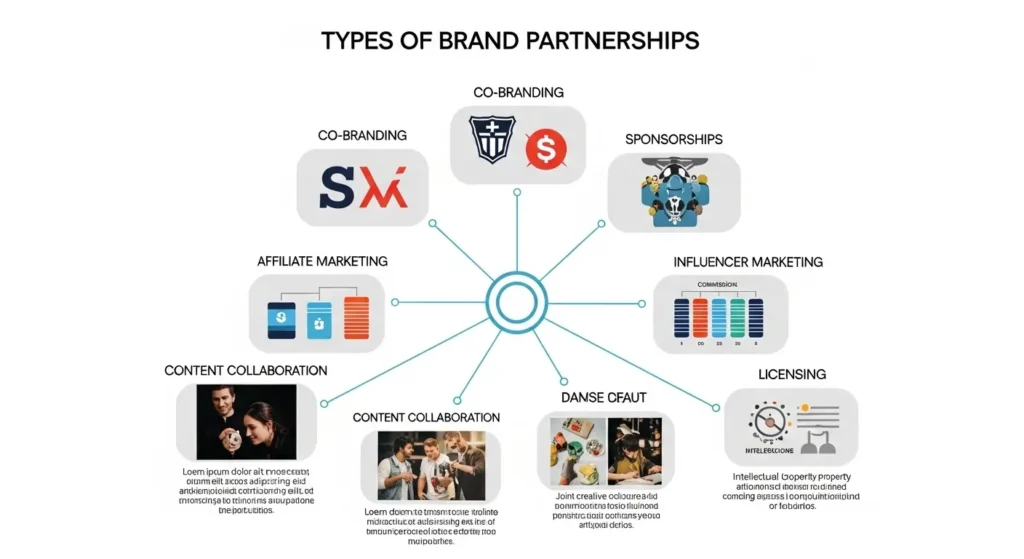
The key trait of choosing a partnership type is alignment. You must choose the format that best fits your specific goals.
- Co-Branding
Two companies come together to create a brand new, physical product that features both of their names and styles.
- Influencer Partnerships
A business teams up with a popular person on the internet to promote their products to that person’s loyal followers.
- Affiliate Partnerships
A brand gives partners a special tracking link, and the partner earns a small commission every time someone buys through that link.
- Sponsorship Partnerships
A company gives money or resources to an event, a team, or a project in exchange for having their logo and name displayed prominently.
- Product Collaborations
Similar to co-branding, but often a limited-time integration where one brand’s product is featured inside another brand’s offering.
- Event Partnerships
Two or more businesses share the cost and the work to host a live or virtual event, like a webinar, a pop-up shop, or a local festival.
- Social Media Collaborations
Brands work together strictly on platforms like Instagram or TikTok to host joint giveaways, live streams, or shared video content.
How to Find the Right Brand Partner
The core trait of a perfect partner is audience overlap without product conflict. You want to talk to the same people without fighting over the same sale.
- Identify your target audience: Know exactly who buys your products, including their age, interests, and habits.
- Choose brands with similar values: If you care deeply about eco-friendly products, exploring brands sustainability partnerships collaborations ensures you match with a brand that also respects the environment.
- Avoid direct competitors: Never partner with a brand that sells the exact same thing as you; instead, find brands that sell complimentary items.
- Analyze audience engagement: Look at their social media or website to make sure their followers actually like and comment on their content.
- Check brand reputation: Do a quick search to ensure the brand is respected and does not have a history of bad customer service.
How to Approach Brands for Partnership
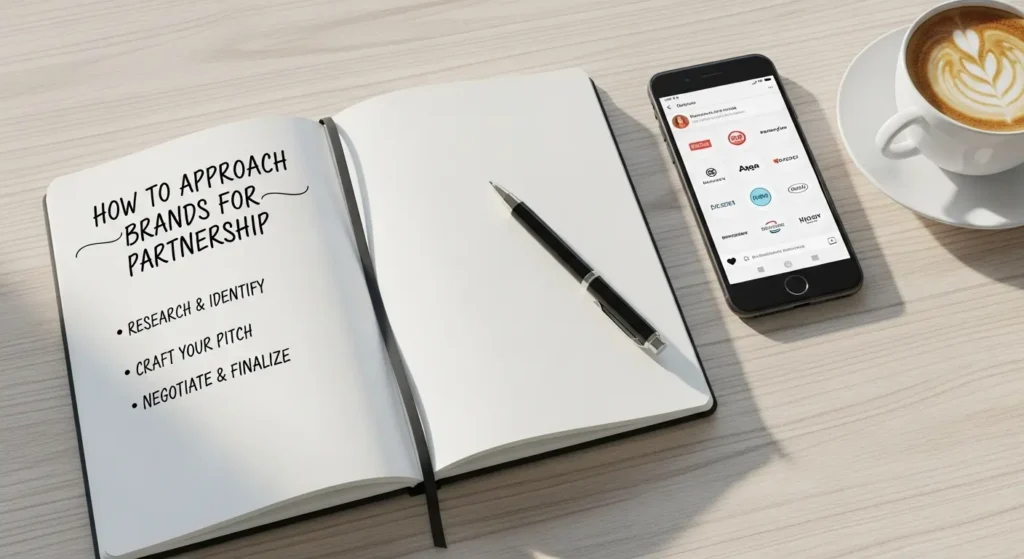
The primary trait of a successful outreach message is focusing on them, not you. People want to know how you can help them succeed.
- Research the brand: Read their recent blogs, look at their new products, and understand what their current goals might be.
- Create a clear collaboration idea: Do not just say “let’s work together.” Bring a specific, exciting idea to the table.
- Highlight mutual benefits: Clearly explain exactly what they will get out of this partnership, whether it is more sales, new leads, or great content.
- Outreach methods: You can send a direct email to their marketing manager, send a professional message on LinkedIn, or even reach out via social media direct messages.
- Follow-up strategy: People are busy. If they do not reply in a few days, send one polite reminder message to bring your idea back to the top of their inbox.
Simple Outreach Email Template
Subject: Collaboration Idea: [Your Brand] + [Their Brand]
Hi [Name],
I have been following [Their Brand] for a while, and I absolutely love your recent work on [mention a specific recent project].
I am reaching out from [Your Brand]. We share a very similar audience, and I have an idea for a [mention the type of partnership, e.g., joint social media giveaway] that I believe would bring great value to both of our communities.
We would handle the heavy lifting on the creative side. Would you be open to a quick 10-minute chat next week to see if this is a fit?
Best regards, [Your Name]
Step-by-Step Brand Partnership Strategy
The trait of a good strategy is organization. Moving step-by-step ensures nothing important is missed.
- Define your goals: Decide exactly what you want to achieve first, like getting 500 new email subscribers or selling 100 specific products.
- Identify potential partners: Make a list of five to ten brands that fit the criteria we discussed earlier.
- Create partnership proposal: Write down a formal document that explains the campaign idea, the timeline, and the expected results.
- Plan campaign: Decide who will design the graphics, who will write the text, and what dates everything will launch.
- Execute collaboration: Launch the campaign to the public exactly as you planned it with your partner.
- Promote across channels: Share the project on your website, your email newsletter, and all of your social media platforms.
- Track performance: Look at your numbers at the end to see if you actually met the goals you set in step one.
Successful Brand Partnership Examples
The best way to understand these concepts is to look at the trait of real-world success. Here are a few of the most successful brand partnerships companies have executed perfectly:
- Red Bull and GoPro: These two brands teamed up for various extreme sports events. Red Bull provided the events and the athletes, while GoPro provided the cameras to capture the amazing footage. What made it successful: Both brands target adventurous, high-energy audiences. Key takeaway: Find a partner whose product perfectly captures or enhances the experience your brand provides.
- Spotify and Starbucks: Starbucks allowed its employees to curate playlists on Spotify, and Starbucks app users could easily find out what music was playing in the store and save it to their Spotify accounts. What made it successful: It connected the physical experience of a coffee shop with the digital experience of a music app. Key takeaway: Look for ways to blend digital services with physical locations to surprise and delight customers.
- Uber and Spotify: Uber allowed riders to connect their Spotify accounts to their Uber app, letting the passenger control the music during their ride. What made it successful: It gave the customer a personalized, fun experience. Key takeaway: Partnerships that give the end-user more control and comfort are almost always a major win.
How to Measure Brand Partnership Success
The trait of smart marketing is relying on data. We cannot just guess if a campaign worked; we must look at the actual numbers.
- Website traffic: Check your analytics to see if more people visited your website during the days the partnership was active.
- Sales and revenue: Track exactly how many products were sold and how much money was made as a direct result of the collaboration.
- Lead generation: Count how many new email addresses or phone numbers you collected during the campaign.
- Social engagement: Look at the number of likes, comments, shares, and new followers your social media accounts gained.
- ROI (Return on Investment): Calculate if the money and time you spent on the partnership brought back a profitable amount of money in the end.
Common Mistakes to Avoid
The main trait of failure in partnerships is rushing. When we rush, we make simple errors. Avoid these common traps:
- Choosing the wrong partner: Teaming up with a brand that has a bad reputation or a completely different audience will waste your time.
- No clear goals: If you do not know what success looks like, you will never know if the partnership actually worked.
- Poor communication: Failing to talk regularly with your partner leads to confusion, missed deadlines, and frustration.
- Unbalanced value exchange: If one brand is doing all the hard work and the other brand is doing nothing, the relationship will fail quickly.
- Not tracking results: If you ignore the data at the end, you will not learn anything for your next big project.
Legal Considerations in Brand Partnerships

The core trait of business law is protection. We want to keep things friendly, but we also must protect our hard work.
- Importance of agreements: Always have a simple, written contract that outlines exactly what each brand promises to do.
- Revenue sharing clarity: If money is being made, the contract must state exactly what percentage of the money goes to each partner and when it will be paid.
- Content ownership: Decide clearly who owns the photos, videos, or articles created during the campaign after the partnership ends.
- Brand guidelines: Make sure your partner knows exactly how they are allowed to use your logo and your brand colors so they do not make you look unprofessional.
Tools to Manage Brand Partnerships
The trait of efficiency requires the right equipment. You do not need to do everything manually.
- Outreach tools: Software that helps you find contact emails and send automated, polite messages to potential partners.
- CRM tools: Customer Relationship Management systems help you keep track of all your conversations with different partner brands in one place.
- Affiliate tracking tools: Platforms that automatically create special links and calculate commissions so you do not have to do the math yourself.
- Analytics tools: Dashboards that track your website visitors and sales so you can measure the exact success of your campaigns.
Expert Tips for Successful Brand Partnerships
The trait of a true expert is patience. After twenty years of writing and strategizing in this industry, here is what I always advise people to do:
- Start small and test: Do not plan a massive, expensive event for your very first partnership. Start with a simple social media post to see how well you work together.
- Focus on long-term relationships: Treat your partners like valuable friends, not just a quick way to make money today.
- Always provide mutual value: Constantly ask yourself, “Is my partner getting just as much out of this as I am?”
- Keep communication clear: Set up a weekly call or a shared chat room so you can talk easily and fix problems before they get big.
- Optimize based on results: Look at what worked well and what failed, and use those lessons to make your next partnership even better.
Conclusion
To summarize, brand partnerships are one of the most powerful and cost-effective ways to grow a business today. By combining forces with another company, you share the workload, lower your costs, and instantly reach new people who are eager to buy.
Do not wait for brands to come to you. Start exploring potential partners today. Look around your local area or your digital space for businesses that share your values and your audience.
The future of brand collaborations is very bright. As advertising gets more crowded, businesses that learn to cooperate and share resources will be the ones that win the trust of the modern consumer.
FAQs
What is a brand partnership example? A great example is when a popular fitness influencer teams up with a healthy snack company to create a custom protein bar. Both the influencer’s fans and the snack company’s customers get excited to try the new product.
How do brand partnerships make money? They make money by introducing products to new audiences who are ready to buy. When a partner promotes your business, their audience trusts the recommendation and clicks over to your website to make a purchase.
Are brand partnerships worth it? Yes, they are highly worth it. They are often much cheaper than running traditional digital advertisements, and they build long-term trust and credibility that money simply cannot buy.
How do I contact brands for collaboration? The best way is to research the brand, find the email of their marketing manager or owner, and send a short, polite message outlining a specific, mutually beneficial idea. You can also use platforms like LinkedIn to make professional connections.